
I recently finished reading AI for Educators: Learning Strategies, Teacher Efficiencies, and a Vision for an Artificial Intelligence Future by Matt Miller as part of a professional book study. The book offers good suggestions for how teachers can utilize artificial intelligence (AI) tools to help with instruction and administrative tasks. I chose this book because many of my colleagues have concerns and questions about the use of AI tools in the classroom. What follows are my thoughts and findings from my research.
AI is Already Here
Like it or not, artificial intelligence (AI) has become a part of our daily lives. We have seen the rise in the use of personal assistants, such as Siri, Google Assistant, and Amazon Alexa, which allow users to set reminders, send messages, play music, and control smart home devices. Social media now uses AI algorithms to determine user preferences and behavior, suggest relevant material, and customize the user experience. AI algorithms are also used by social media companies to help identify and eliminate fake news, hate speech, and other harmful content. Many businesses are using virtual assistants and chatbots powered by AI to offer 24/7 customer services, such as tracking orders and processing returns. E-commerce sites, like Amazon, provide customers with product recommendations based on their search queries and browsing histories. AI has also made its way into healthcare with patient monitoring, medication research, and medical imaging analysis. For example, Merative uses AI to analyze medical images and assist doctors with making diagnoses. The medical app Ada uses AI to help users identify symptoms and connect with healthcare professionals.
The Role of AI in Education
According to Chen et al. (2020), the use of AI “in education has had a major impact, including improved efficiency, global learning, customized/personalized learning, smarter content, and improved effectiveness and efficiency in education administration among others” (p. 75265). Some uses of AI in instruction include interactive learning environments (ILEs) which manage student performance and feedback exchanges between students and teachers. Many schools currently use intelligent tutoring systems like MATHia for mathematics, ClearFLuency for reading, World Language Immersion for learning a foreign language. There are also adaptive learning systems such as Pearson’s Interactive Labs for science. AI can also support teachers and students through grading and feedback. Examples of some of these applications include Grammarly (grammar check), Ecree (provides immediate feedback and guidance when writing), and TurnItIn (streamlines the grading and feedback process).
AI can also help teachers plan instruction. Miller (2023) offers the following ways that AI assistants, like ChatGPT, can be used to increase teacher efficiency:
- Create review content, questions, and activities
- Provide student feedback for written work
- Write report card comments or help compose parent emails
- Summarize texts
- Create leveled text sets
- Generate prompts and questions to facilitate discussions
- Create a virtual lab
- Create presentation slides
- Write content for IEPs – help with writing rationales for goals
- Writing letters of recommendation
In summary, AI can be used to automate and expedite administrative tasks for both schools and teachers by grading homework and evaluating essays which frees up more time for teachers to work with students one-on-one. Through the use of AI, students have “richer learning experience[s] because AI uses machine learning to assess capabilities and needs, and subsequently, with the findings of such analysis, develop and disseminate personalized or customized content, which ensures higher uptake and retention, thereby improving learning” (Chen et al., 2020, p. 75276). AI can also help students who are at a disadvantage when compared to their peers. This might include students who have no support system at home to help them proofread their papers or look over their homework.
Concerns About the Use of AI in Education
One of the biggest concerns regarding the use of AI in education is that some students may use it to engage in academic dishonesty. Some would also include plagiarism here, but this is a grey area. Miller (2022) states that work created by AI legally “isn’t intellectual property owned by anyone” (p. 83). Miller also feels that society’s definition of “cheating” will change in response to AI becoming more prominent in our work and personal lives. This is why it is imperative that we teach students how to ethically and responsibly use AI as a tool and combine it with their human skills.
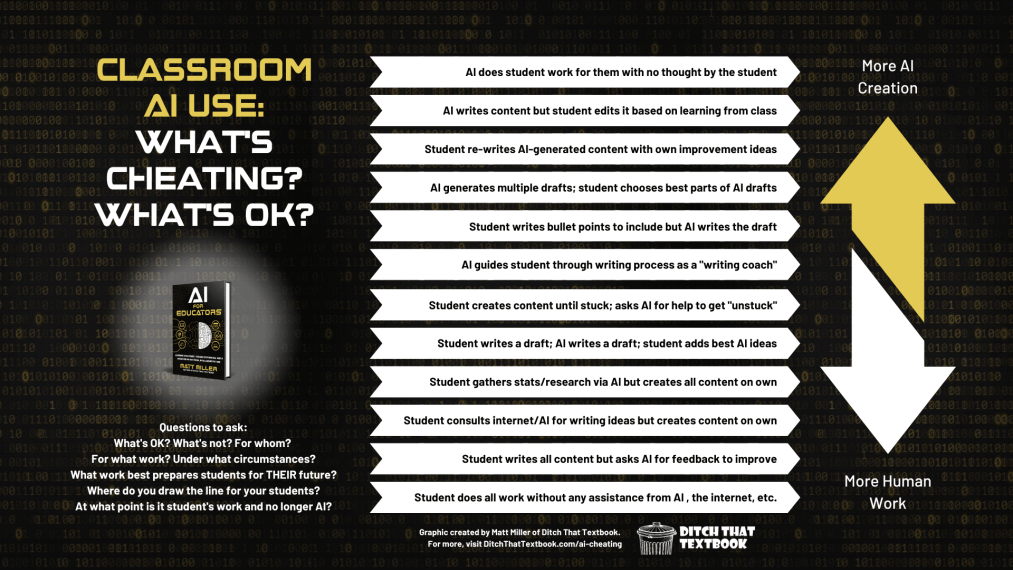
Another big concern about the use of AI by students deals with data. Some of the questions we need to consider when we use AI tools are: what data is being collected, and who has access to this data? If data is being collected, we need to ensure that privacy laws are being followed (Miller, 2023). Another data concern deals with accuracy and bias.
A final concern surrounding AI is that it might one day replace teachers in the classroom. Many argue that this is unlikely to happen because AI cannot connect with students in the classroom the way a human teacher can because it is not capable of feeling emotions. This implies that AI would be “incapable of truly empathizing with its students in the classroom … or reading the mood of the class when teaching and adapting its performance accordingly” (Guigerme, 2019, p. 52). AI also would not be able to utilize common classroom management techniques employed by human teachers, such as the use of tone of voice, facial expressions or looks, and physical proximity to help redirect off-task behaviors. In their study, Frey and Osborne (2017), concluded that teaching is among the hardest professions to automate with AI because of its focus on social-emotional skills.
While concerns do exist, Chen et al. (2020) found in their review of the literature that the “benefits of AI to learning supersede the challenges” (p. 75275). These benefits along with the increasing use of AI in the world mean we must teach our students how to use AI responsibly and ethically.
References
Chen, L., Chen, P., & Lin, Z. (2020). Artificial Intelligence in education: A Review. IEEE Access, 8, 75264–75278. https://doi.org/10.1109/access.2020.2988510
Frey, C. B., & Osborne, M. A. (2017). The future of employment: How susceptible are jobs to computerisation? Technological Forecasting and Social Change, 114, 254–280. https://doi.org/10.1016/j.techfore.2016.08.019
Guilherme, A. (2019). AI and education: The importance of teacher and student relations. AI & SOCIETY, 34, 47–54. https://doi.org/10.1007/s00146-017-0693-8
Miller, M. (2023). AI for educators: Learning strategies, teacher efficiencies, and a vision for an artificial intelligence future. Ditch that Textbook.
Miller, M. (2023). Classroom AI use: What’s cheating? What’s OK? [Photograph]. Ditch that Textbook. https://ditchthattextbook.com/ai-cheating/
Mayo Clinic. (n.d.). Using artificial intelligence in radiology clinical practice [Video]. YouTube. https://www.youtube.com/watch?v=dCDuMyzWS8Q
 Ed Tech Wolfe
This blog is extremely eye opening to me in the world of AI. You are right in that it is not going away. In some senses as you mentioned, it is helpful in some ways. However, it scares me somewhat to know how it may hurt our nation in the future. How will it affect us in education? Will teachers still be needed as much? Yikes! I definitely think it is necessary to educate teachers on AI and students on how to best use AI. I love your comment that “this is why it is imperative that we teach students how to ethically and responsibly use AI as a tool and combine it with their human skills.” Great information!
-Caprice Buttram
LikeLike