I recently read “Chapter 6: Planning and Budgeting” from The Technology Coordinator’s Handbook. In this chapter, the authors discuss the role of the technology coordinator when it comes to technology planning and budgeting. The technology coordinator is responsible for “articulating a vision for technology use in the school or district; establishing a clear, achievable plan for making that vision a reality; and working with administrators and the board of education to find the resources” (Frazier & Hearrington, 2017, p. 166) to implement the plan.
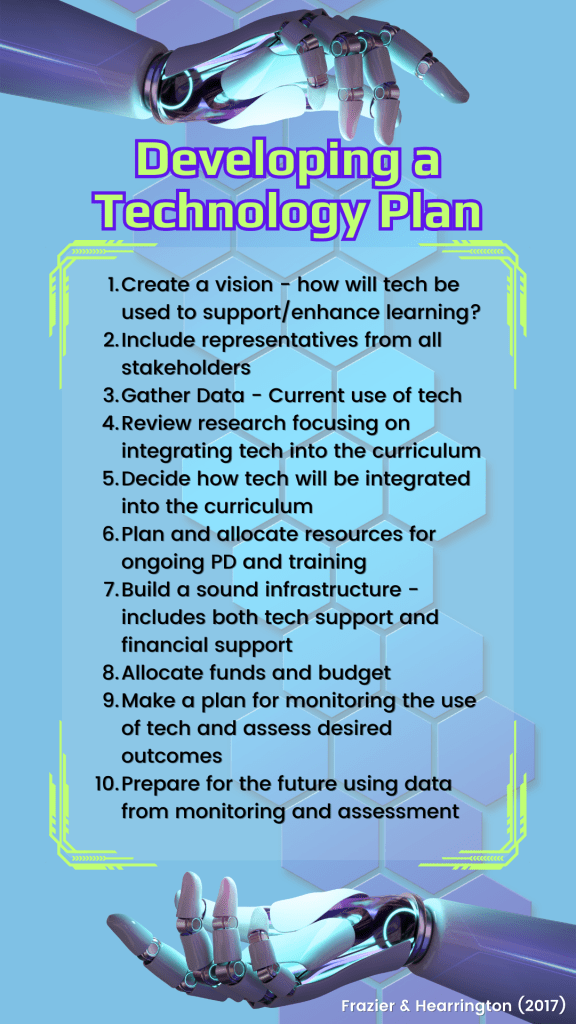
Frazier and Hearrington (2017) recommend that a technology plan contain at least the ten elements displayed in the infographic to the right. From the infographic, one can see that a solid technology plan does not just focus on equipment. The plan must consider the current state of technology in the district, where the district would like to be in three to five years, a list of resources needed to succeed, and an implementation guide when these resources are in place.
Workflow Suggestions
The authors propose the following workflow when starting to review and develop a technology plan (Frazier, 2019; Frazier & Hearrington, 2017).
- Create a SWOT (Strengths, Weaknesses, Opportunities, and Threats) Analysis document incorporating the International Society of Educational Technology’s (ISTE) Essential Conditions for Effective Tech Use in Schools (ISTE, 2024).
- Identify the SWOTs for each of the Essential Conditions by considering the condition from multiple perspectives. Be sure to gather evidence to support the identified statements.
- Create a TOWS matrix for each of the Essential Conditions using the SWOTs identified in the previous step.
- Use the TOWS matrix to consider the following.
- How can strengths be used to maximize opportunities?
- How can strengths be used to minimize identified threats?
- How can identified weaknesses be minimized using opportunities?
- How can weaknesses be minimized and identifiable threats avoided?
- Let stakeholders vote to prioritize strategies and decide which should be considered in the technology plan.
Critical Areas to Remember
After reading the text, I engaged in a discussion with my colleagues regarding the process of planning and budgeting for technology in schools. Based on my reading and our reflection, I came away with the two important elements that are critical to not overlook: professional development and equitable access.
When developing a technology plan, it can be easy to overlook “the allocation of resources for professional development and training” (Frazier & Hearrington, 2017, p. 172). Teachers need to learn how to use technology and how it can be used to enhance student learning by developing twenty-first-century skills. Ireh (2010) views this as the most critical budget item since a district is likely to achieve the goals outlined in its technology plan if teachers and staff do not know how to use the technology they are provided. Some districts even budget for Instructional Technology Coaches in each building to support teachers and encourage continued growth in ways that technology can support student learning (O’Shea & Trainin, 2021).
Another critical element to consider in planning is digital equity. In particular, Internet access at home. The sudden shift to online learning when the COVID-19 pandemic hit made clear that not all students had equitable Internet access at home (O’Shea & Trainin, 2021; Salsbury & Hansen, 2022). Many schools provided students with hot spots to use so they could access the Internet and attend online classes. The U.S. Congress allocated money to fund the Affordable Connectivity Program which allowed families that qualified access to free or reduced-cost Internet. Sadly, schools are no longer receiving the extra funds to pay for hot spots, and the Affordable Connectivity Program stopped accepting applications on February 7, 2024. Barring any additional funding from Congress, the program is expected to run out of money in April 2024 (Federal Communications Commission, 2024).
President Bidden recently announced the Internet for All initiative. While the program is offering each state money to improve their broadband infrastructure, there is still the issue of affordability. From the Internet for All website, it is unclear if any money will be available to help those families living in poverty get affordable access to broadband Internet. Often, teachers may not know whether or not students have access to the Internet at home. Students and parents may be embarrassed to reveal that they cannot afford Internet access, or they may not know how to ask for assistance. Providing students with devices does not do much good if they cannot use them to access information while the students are at home. Researching available programs as they become available will be critical for ensuring that all students can access the Internet from home and have equal access to online learning.
References
Federal Communications Commission. (2024). Affordable connectivity program. https://www.fcc.gov/acp
Frazier, M. (2019, January 30). ISTE 5 tips to get started with technology planning. International Society for Technology in Education. https://iste.org/blog/5-tips-to-get-started-with-technology-planning
Frazier, M., & Hearrington, D. (2017). The technology coordinator’s handbook (3rd ed.). International Society for Technology in Education.
Ireh, M. (2010). Budgeting and funding school technology: Essential considerations. School Business Affairs, 76(7), 18–20.
Lennox, J., Reuge, N., & Benavides, F. (2021). UNICEF’s lessons learned from the education response to the COVID-19 crisis and reflections on the implications for education policy. International Journal of Educational Development, 85. https://doi.org/10.1016/j.ijedudev.2021.102429
News4JAX The Local Station. (2023, June 26). Biden announces how billions for expanding broadband internet are being distributed [Video]. YouTube. https://www.youtube.com/watch?v=s5wrXbSemSk
O’Shea, C. M., & Trainin, G. (2021). How did we get here? One district’s approach to device assisted learning technology implementation. Journal of School Administration Research and Development, 6(2), 99–106.
Salsbury, M., & Hansen, M. A. (2022). Bridging the digital divide: Wi-Fi hot spots as a means of digital equity. Portal: Libraries and the Academy, 22(1), 199–219.
Tomer, A., Fishbane, L., Siefer, A., & Callahan, B. (2020, February 27). Digital prosperity: How broadband can deliver health and equity to all communities. Brookings Institution. https://www.brookings.edu/articles/digital-prosperity-how-broadband-can-deliver-health-and-equity-to-all-communities/#:~:text=Because%20broadband’s%20applications%20are%20so,collective%20health%20and%20equity%20outcomes.
United States Government. (2024). Internet for all. https://www.internetforall.gov/
 Ed Tech Wolfe