Planning Ahead: Helping Teachers to Become Digital Citizenship Champions

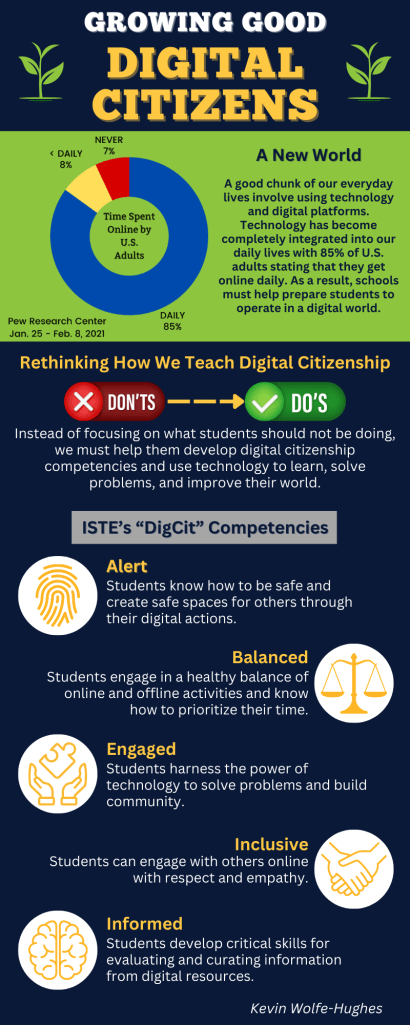
This Spring, I have been enrolled in a graduate course about digital leadership. For one of the modules, I created the infographic at the right. I shared the infographics with the teachers at my school to hopefully plant a seed for change. Too often our attempts at teaching digital citizenship end up being a list of “Don’ts” instead of guiding students to practice and develop the behaviors that exemplify a good digital citizen.

Before the COVID-19 pandemic shut down in-person instruction at my school, the staff had started looking at incorporating the Alabama Digital Literacy Standards (Alabama State Department of Education [ALSDE], 2018) into each of our content areas. With the pivot to online instruction, this endeavor was placed on the back burner and soon forgotten. In my new role as the Instructional Tech Specialist at my school and as a result of this course, I believe now is a good time to start thinking about this again and how we can help our students become good digital citizens.
The Importance of Digital Citizenship

Öztürk (2021) defines digital citizenship “as the online display of behaviors that ensure legal, safe, ethical, and responsible use of information and communication technologies” (p. 33). The International Society for Technology in Education (ISTE) views digital citizenship as a concept that both teachers and leaders are responsible for teaching to students. This is such an important concept that ISTE has digital citizenship standards in place for instructional leaders, teachers, and students. Teachers are expected to “inspire students … to positively and responsibly participate in the digital world” (ISTE, 2019a, 2.3 Citizen section). Instructional leaders are expected to “model digital citizenship and support educators and students in recognizing the responsibilities and opportunities inherent in living in a digital world” (ISTE, 2019b, 4.7 Digital Citizen Advocate section). In addition to the ISTE standards, Alabama also has a “Citizens of a Digital Culture” (Alabama State Department of Education, 2018, p. 4) standard that recurs throughout grades K-12.

With the increased use of technology, our world is becoming more and more interconnected. This makes digital citizenship a global concern. With the increase in online learning, schools need to integrate digital citizenship across the curriculum to promote responsible and productive digital citizens (Capuno et al., 2022; Hamayel & Hawamdeh, 2022).

Digital Leaders and Digital Citizenship

Even though our current generation of students have grown up in a world heavily reliant on technology, that does not mean they know how to use technology effectively and responsibly. Many students “do not have a sense of the competencies to use it to support their learning or protect their identity” (Sheninger, 2019, p. 110). After reading Sheninger’s book, Digital Leadership, I feel that now is the time to start planning how my school can incorporate digital citizenship instruction into our curriculum.

I have decided to make this my summer project to engage in conversations with our Assistant Principal for Instruction about how we can plan to incorporate professional learning experiences throughout the school next year to help teachers incorporate digital citizenship into their courses. Based on Sheninger’s (2019) description of the Pillars of Digital Leadership, I have identified several pillars that will come into play as we plan.

Professional Learning & Growth – Much like Sheninger did with his teachers and students, I think it is important to create a professional learning community where everyone in the school shares what they are learning about digital citizenship and what questions they still have. This supportive and collaborative environment will help us to problem-solve and develop innovative ideas (Voogt et al., 2015).

Student Engagement & Learning – While there are plenty of online activities for teaching digital citizenship from sources like Google for Education and Common Sense Media, I think teachers will need to work together to adapt these activities for their specific subject areas and projects they are already using in their classrooms. Since digital citizenship encompasses problem-solving, information processing and creativity, content communication, and security (Hamayel & Hawamdeh, 2022), I am sure there are many existing activities that teachers are already using that can be tweaked to incorporate components of digital citizenship. By collaborating together through a professional learning community to adapt existing ideas or create new ones that align with the needs and realities of their students and community, teachers have ownership which increases their motivation and commitment to implementing their ideas effectively (Voogt et al., 2015).

Communication – To effect real change, we need to foster collaboration between our school, parents, and community to address the challenges and risks associated with technology use (Baydar, 2022). Many of the parents of our students are not digital natives and may not know how to discuss digital citizenship topics with their children. Inviting them to share in our journey will help encourage conversations about digital citizenship to continue outside of the school at home.

Closing Thoughts

I feel that the course I have completed on digital leadership has proven valuable in providing a frame of reference to help organize and plan the process of working with my colleagues to learn about digital citizenship together. From this collaboration, I am excited to see what wonderful ideas we will develop to enhance student learning. What started as the creation of a simple infographic has grown into a new opportunity for my school to grow and empower our students to become good digital citizens.

References

Alabama State Department of Education. (2018). Alabama course of study: Digital literacy and computer science. https://www.alabamaachieves.org/wp-content/uploads/2023/11/AS-2018-Digital-Literacy-and-Computer-Science-COS.pdf

Baydar, F. (2022). The role of educational leaders in the development of students’ technology use and digital citizenship. Malaysian Online Journal of Educational Technology, 10(1), 32-46. https://doi.org/10.52380/mojet.2022.10.1.367 

Capuno, R., Suson, R., Suladay, D., Arnaiz, V., Villarin, I. & Jungoy, E. (2022). Digital citizenship in education and its implication. World Journal on Educational Technology: Current Issues, 14(2), 426-437. https://doi.org/10.18844/wjet.v14i2.6952

Hamayel, H. J., & Hawamdeh, M. M. (2022). Methods used in digital citizenship: A systematic literature review. Journal of Digital Educational Technology, 2(3), 1-7. https://doi.org/10.30935/jdet/12520

International Society for Technology in Education. (2019a). ISTE standards: For educators. https://iste.org/standards/educators

International Society for Technology in Education. (2019b). ISTE standards: For coaches. https://iste.org/standards/coaches

Öztürk, G. (2021). Digital citizenship and its teaching: A literature review. Journal of Educational Technology & Online Learning, 4(1), 31-45.

Sheninger, E. (2019). Digital leadership: Changing paradigms for changing times (2nd ed.). Corwin; International Center for Leadership in Education.

Voogt, J., Laferrière, T., Breuleux, A., Itow, R. C., Hickey, D. T., & McKenney, S. (2015). Collaborative design as a form of professional development. Instructional Science, 43(2), 259–282. https://doi.org/10.1007/s11251-014-9340-7

Maintaining the Privacy and Security of Student Data

Recently, I found myself engaged in a discussion with some colleagues regarding security and ensuring that district and federal policies were being followed regarding student privacy and the security of student data. The teachers did not understand why they could not use a free digital resource with their students. This particular resource allowed users to utilize single sign-on with their school-issued Google accounts. The teachers’ thinking was that it was safe to use this resource because it was free and students did not have to create an account on the website. 

This conversation was very informative to me. While most teachers are aware of the Family Educational Rights and Privacy Act (FERPA), their view of privacy protection seems to be lacking a digital lens. As an Instructional Tech Specialist, I provide leadership in the area of student engagement and learning. This is one of the Pillars of Digital Leadership described by Sheninger (2019). Sheninger also describes this leadership role as being influenced by the Future Ready Framework–the Data and Privacy area in particular.

Privacy Laws

Two main federal laws regulate the privacy and security of student data: the Family Educational Rights and Privacy Act (FERPA) and the Children’s Online Privacy Protection Act (COPPA). 

Importance of Vetting Resources

Even with these laws in place, there are still issues with vendors not being completely transparent with their privacy policies or disregarding the requirements outlined in COPPA altogether (Frazier & Hearrington, 2024). For example, vendors who offer free services often share collected data with third parties to make money. These third parties can use this data to develop profiles of children and build behavioral ads targeting these children.

When viewed from the Data and Privacy area of the Future Ready Framework (All4Ed, 2024), technology leaders must ensure that procedures are in place to vet all digital resources to verify their educational value and security. When it comes to educational value, the resource should be judged on its ability to help teachers and students achieve learning targets. The content should also be developmentally appropriate for the intended age group. Considering security, the vendor of the resource “should encrypt user data to provide a basic assurance of security, especially products housing student data” (Zimmerle, 2021). As mentioned above, federal laws require that vendors clearly state within their privacy policies what data is collected from students and how that data is used. This is where the issue with free resources comes into play. Many free resources actually make money from selling or sharing student data. Often this data is used to create contextual or targeted advertising (Kelly, Graham, & Garton, 2023; Zimmerle, 2021).

Privacy Information Resources

Common Sense has a Privacy Program that evaluates the privacy policies of popular products to help schools and parents make informed decisions about the tools their students are using. Privacy evaluations are provided for a range of apps along with explanations of the ratings. Common Sense also provides access to publications, written by privacy law experts, that share information on important issues surrounding digital citizenship and student learning.

One such publication, the 2023 Privacy Program Evaluation Framework (Kelly, Graham, & Garton, 2023), assesses products using “multiple dimensions of privacy, safety, security, and compliance, incorporating criteria based on legal, societal, educational, and child development practices” (Common Sense Media, n.d.). The appendix of this report is extremely useful. When evaluating a product based on a specific component of law, the links in the appendix navigate to the questions that should be considered in the evaluation process.

Vetting Recommendations

Zimmerle (2021) recommends educating teachers on the law and why vetting is so important especially when it comes to free resources. Even if teachers have been trained on the importance of security and privacy of student data, the Federal Trade Commission (FTC) states that it is best practice for school districts to vet online resources instead of leaving it up to teachers (2020, July).

Note. From Adopting Ed Tech: Privacy Vetting [Video], by Student Privacy Compass, 13 August 2020, YouTube (https://www.youtube.com/watch?v=lU8v1orttis&t=629s)

When vetting resources, Student Privacy Compass, formerly known as FERPA|Sherpa, suggests asking the following ten questions (Gallagher, Magid, & Pruitt, 2021, p. 9 ).

  1. Does the product collect PII?
  2. Does the vendor commit not to share student information other than as needed to provide the educational product or service? The vendor should clearly promise never to sell data.
  3. Does the vendor create a profile of students, other than for the educational purposes specified?
  4. When you cancel the account or delete the app, will the vendor delete all student data that has been provided or created?
  5. Does the product show advertisements to students? Behaviorally targeted advertising is never acceptable for school use.
  6. Does the vendor allow parents to access data it holds about students or enable schools to access data so the school can provide the data to parents in compliance with FERPA?
  7. Does the vendor promise to provide security for the data it collects? Look for products that use encryption when storing and transmitting student data.
  8. Does the vendor claim it can change its privacy policy without notice at any time? The FTC requires vendors to provide notice to users when their privacy policies change and get new consent for the collection and use of their data.
  9. Does the vendor say that if the company is sold, all bets are off? The policy should state that any sale or merger will require the new company to adhere to the same protections.
  10. Do reviews or articles about the product or vendor raise any red flags?

Closing Thoughts

Thinking back to Sheninger’s (2019) description of the roles and qualities of an effective digital leader, I examined how I might be a more effective leader with regard to helping teachers understand the importance of Data and Privacy. With this in mind, I have redesigned my training with teachers to incorporate more of the information about the law and good practices I discovered in my research here. Before teachers request permission from the district to utilize new digital resources, they will now be able to examine these resources from a Data and Privacy perspective.

References

Children’s Online Privacy Protection Act of 1998, 15 U.S.C. §6501 et seq. (1998). https://www.govinfo.gov/content/pkg/USCODE-2022-title15/pdf/USCODE-2022-title15-chap91-sec6501.pdf 

Common Sense Media. (n.d.). Common sense privacy program: Publications. Retrieved from https://privacy.commonsense.org/resource/publications  

Family Educational Rights and Privacy Act of 1974, 20 U.S.C. § 1232g et seq. (1974). https://www.govinfo.gov/content/pkg/USCODE-2022-title20/pdf/USCODE-2022-title20-chap31-subchapIII-part4-sec1232g.pdf   

Federal Trade Commission. (2020, July). Complying with COPPA: Frequently asked questions. Retrieved from https://www.ftc.gov/business-guidance/resources/complying-coppa-frequently-asked-questions 

Frazier, M., & Hearrington, D. (2024). The technology coordinator’s handbook (4th ed.). International Society for Technology in Education.

Gallagher, K., Magid, L., & Pruitt, K. (2021). The educator’s guide to student data privacy. Student Privacy Compass. Retrieved from https://studentprivacycompass.org/audiences/educators/ 

Kelly, G., Graham, J., & Garton, S. (2023). 2023 Privacy Program Evaluation Framework. Common Sense Media.

Sheninger, E. (2019). Digital leadership: Changing paradigms for changing times (2nd ed.). Corwin; International Center for Leadership in Education.

Student Privacy Compass (2020, August 13). Adopting EdTech: Privacy vetting [Video]. YouTube. https://www.youtube.com/watch?v=lU8v1orttis&t=629s 
Student Privacy Compass (2024). Welcome to student privacy compass. https://studentprivacycompass.org/