Looking Forward: Continuity Plans

In my graduate class on distance learning, we examined continuity of instruction. As a starting point for my exploration, I looked at the Continuous Learning Rubric v2.1 (ClassLink et al., n.d.). Three elements from this document resonated with me as an Instructional Tech Specialist: instructional delivery method, professional development, and communication. I chose these three elements because they were areas that I could focus on with our Assistant Principal for Curriculum and Instruction to help support our students, parents, and faculty.

Instructional Delivery Method

An instructional delivery method is described as an outline of the instructional delivery methods for various scenarios (ClassLink et al., n.d.). At my school, I train the teachers on using Schoology, our Learning Management System (LMS). One thing we could do is utilize Schoology to help ensure the continuity of instruction is maintained with respect to teacher absences and school closures. Miami-Dade County Public Schools (2023) have a well-designed plan for teacher absences and school closures. Their plan for teacher absences covers two scenarios: planned and unplanned absences. If an absence is planned in advance, the district has teachers post the lesson on Schoology so that it can be completed asynchronously in class. The substitute teacher directs students to access Schoology and begin work on the lesson.

For unplanned absences, the district has teachers create a folder labeled “Emergency Lesson Plans” in Schoology at the beginning of the school year. The folder is left unpublished for students. Teachers are expected to routinely update the emergency lessons in this folder so the plans remain current with where students are in the course. When a teacher calls in an unplanned absence, the LMS manager accesses the teacher’s Schoology classes and publishes the lesson plan. Again, the substitute teacher would simply direct students to access Schoology and begin work on the lesson.

In the event of school closures, Miami-Dade County Public Schools (2023) follows a similar procedure: Teachers place asynchronous work in Schoology for students to complete. The Miami-Dade policy directs teachers to be flexible with deadlines for work to be completed when there is bad weather, which could affect access to power and Internet service. We have a similar procedure at my school for e-Learning days during emergency school closures. Unfortunately, these are stand-alone lessons that may or may not be related to the content students are currently covering in class. In order to maintain continuity in the course, the lessons should really reflect what the students are currently covering in class.

My school does not use Schoology like Miami-Dade does when teachers are absent. I think it’s important to revise our existing policies to improve how we promote the continuity of learning in our school based on Simonson and Zvacek (2024), who emphasize the importance of revising institutional policies to assess readiness for distance education. Students and parents need opportunities to practice utilizing Schoology to complete online lessons so that they know how to function online. This is important considering how unprepared students, parents, and teachers were to switch to online learning during the pandemic.

Professional Development

If teachers are expected to incorporate opportunities for distance learning within Schoology to maintain the continuity of learning, it is important that they are trained to do so. Teachers need training on the tools the district has chosen for instruction and support for developing the pedagogical skills needed when teaching remotely (ClassLink et al., n.d.). Simonson and Zvacek also stress that “appropriate faculty training is an absolutely imperative readiness concern” (2024, p. 308). While we do provide teachers with ongoing professional learning opportunities for face-to-face classroom instruction, I think it is worthwhile to incorporate best practices in teaching online. Utilizing the embedded planning time in our school schedule, teachers within the same content area can work together to plan online lessons with the same level of academic rigor as face-to-face instruction (Simonson & Zvacek, 2024).

Teachers will likely need the most help ensuring their online materials are accessible. This involves considering the limitations of the LMS and related applications, ensuring software compatibility with assistive devices, and aligning resources with WCAG 2.2 standards (Simonson & Zvacek, 2024). We must ensure that all students, including those with Individualized Education Plans or 504 Plans, can also access and interact with the lessons teachers post online. This will require the expertise of special education teachers in the planning and review process.

Note. From Introduction to web accessibility and W3C standards. [Video], by W3C Web Accessibility Initiative (WAI), 4 December 2017, YouTube (https://youtu.be/20SHvU2PKsM)

Communication

Schools should continuously communicate with all stakeholders about operations, policies, and instruction (ClassLink et al., n.d.). Part of my job at my school is to maintain the school’s website. Currently, we do not have any information on the website about our continuity plan. In researching this topic, I discovered the Miami-Dade County Public Schools Continuity Plan (2024) posted on their website. One of the features I like about their site is that it houses all of the information in one location. Stakeholders can find information regarding the Instructional Continuity Plan, school devices, the district’s LMS, support documents, self-help videos, and contact information for live support. Communication is key in supporting both students and parents to successfully navigate and participate in online learning opportunities (Simonson & Zvacek, 2024).

With my district moving to a 1:1 device model this year, students and parents will need access to information about how to use the school device they will be issued. Providing parents with information on Schoology and how they can create a parent account to support their student’s learning would also be beneficial since middle school is the first time that Schoology is used extensively across all classes. For many parents (and students), I think it would be helpful to offer in-person training on how to get the most out of Schoology. By communicating this information with parents and students, I believe that we can all work together to support our students when they have to participate in online learning.

Closing Thoughts

I’m currently writing this post during the summer. The teachers are enjoying their break, and I’m using this time to prepare for the upcoming 2024-2025 school year. It’s an ideal time to collaborate with my building administrators and start thinking about professional learning opportunities to help our teachers develop the pedagogical skills to develop effective online lessons that can be used with our students. By providing online learning opportunities to our students, they will develop the skills to be successful in their online assignments. This will help to ensure that we are prepared to continue learning no matter what disruptions may occur.

References

ClassLink, American Association of School Administrators, Association of Educational Service Agencies, Consortium for School Networking, & State Educational Technology Directors Association. (n.d.). Continuous learning rubric v2.1. https://docs.google.com/spreadsheets/d/1lXAwsLWBfNslkhIGxHqgojVjmV5n8KIrR7SCmZnNqsA/edit?gid=1000901060#gid=1000901060

Miami-Dade County Public Schools. (2024). M-DCPS instructional continuity plan. Retrieved June 22, 2024, from https://icp.dadeschools.net/#!/fullWidth/7271

Miami-Dade County Public Schools. (2023). Best practices to ensure the continuity of instruction. Innovation and School Choice. Retrieved June 22, 2024, from https://innovationschoolchoice.com/instructional-continuity/

Simonson, M., & Zvacek, S. (2024). Teaching and learning at a distance: Foundations of distance education (8th ed.). Information Age Publishing, Inc.

W3C Web Accessibility Initiative (WAI). (4, December 2017). Introduction to web accessibility and W3C standards [Video]. YouTube. https://youtu.be/20SHvU2PKsM

World Wide Web Consortium. (2024). WCAG 2 overview. W3C Web Accessibility Initiative (WAI). Retrieved June 22, 2024, from https://www.w3.org/WAI/standards-guidelines/wcag/

E-Portfolios as a Useful Assessment Tool in Distance Learning

Simonson and Zvacek (2024) define assessment as “the process of measuring, documenting, and interpreting behaviors that demonstrate learning” (p. 242). Assessment serves as a crucial feedback mechanism for both students and teachers. For students, it offers insights into their progress toward meeting course objectives, enabling them to make necessary adjustments and take responsibility for their learning. For teachers, assessment feedback provides an understanding of the effectiveness of instruction and course activities in facilitating student mastery of objectives, allowing them to make informed adjustments as needed.

For assessments to be effective, they must exhibit alignment, validity, reliability, and practicality (Simonson & Zvacek, 2024). Alignment pertains to the extent to which the assessment corresponds with the course objectives, both conceptually (content) and cognitively (thinking skills). Validity refers to the extent to which an assessment accurately measures its intended constructs. Reliability denotes the consistency and stability of an assessment in measuring its intended outcomes. Practicality involves considering factors such as the time required for students to complete the assessment, the resources needed, the time needed for scoring, and the usefulness of the information obtained from the assessment.

Portfolios as an Assessment Tool

Electronic portfolios (e-portfolios) can be utilized for both formative and summative assessments (Allman et al., 2021; Simonson & Zvacek, 2024). The type of assessment is determined by the tasks incorporated within the e-portfolio. Activities focusing on critical thinking, self-assessment, and self-reflection are formative, as they enable learners to gain deeper insights into their learning journey and connect theory with practice (Song, 2021). For summative assessment, specific activities must explicitly link the learner’s skills, knowledge, and accomplishments to the course’s desired learning outcomes (Song, 2021). When the task in the e-portfolio is used for summative assessment, the rubric and score should not be documented within the e-portfolio, especially in cases where the e-portfolio is shared publicly with others (Chang & Kabilan, 2024). In cases like this, it is better to communicate the score and rubric with feedback directly to the student through the course management system.

Chang and Kabilan (2024) contend that electronic portfolios (e-portfolios) offer a more authentic method for evaluating student learning and program success for administrators. Additionally, e-portfolios foster collaborative, reflective, and integrative learning (Chang & Kabilan, 2024; Song, 2021). Students exercise ownership over their learning by selecting artifacts and utilizing various modes of expression, including oral, video, visual, and written formats (Chang & Kabilan, 2024; Simonson & Zvacek, 2024). Moreover, students generally hold favorable attitudes towards e-portfolios for both assessment and learning, which is likely due to the connections they make between course content and their career aspirations (Allman et al., 2021).

E-portfolios have the potential to be a useful tool for assessment when designed correctly. In general, e-portfolios exhibit high validity because they allow students to independently gather, select, and reflect on evidence of their learning for formative purposes (Lam, 2023). Care should be taken to prevent the contents of the e-portfolio from being too narrowly defined as this may decrease the validity since students end up simply providing content rather than engaging in reflective thinking (Lam, 2023). While it does appear that well-defined rubrics aligned to the desired learning outcomes of the course increase reliability, more research is needed to clarify the reliability of e-portfolios (Lam, 2021, 2023). Finally, the practicality of e-portfolios depends on the computer literacy of both the students and instructors to manage their e-portfolios.

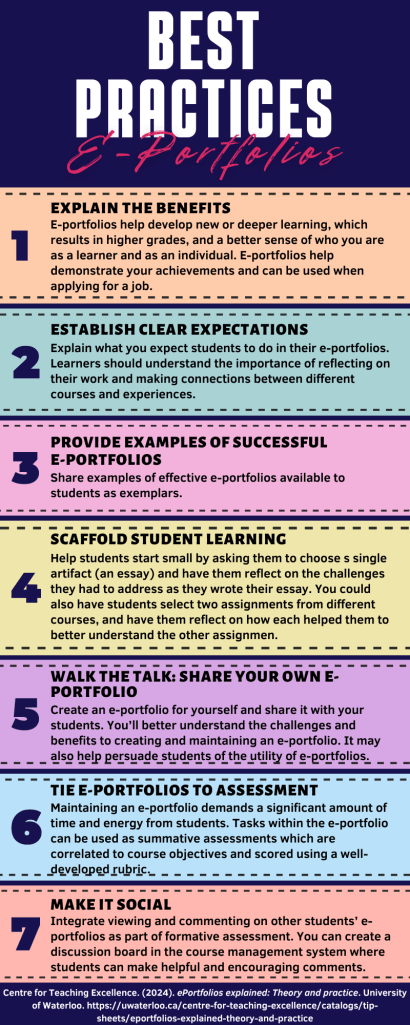
At the right are some best practices for instructors to consider when using e-portfolios with their students (University of Waterloo Centre for Teaching Excellence, 2024). In addition, the University of Waterloo provides an example of one of their student’s e-portfolios.

Digital Tools for e-Portfolios

Several digital tools support the creation of e-portfolios. These include  FolioSpaces (free), Blackboard ePortfolio, Digication ePortfolios, and Mahara. As mentioned above, students need to be aware of e-portfolio expectations before and during their engagement with their e-portfolios. In addition, to realize the full benefits of using e-portfolios, students need continuous support with the technological aspects of the e-portfolio system.

Note. From What is FolioSpaces? [Video], by FolioSpaces, 25 May 2016, YouTube (https://www.youtube.com/watch?v=cKeWzxBZAy4&t=5s)

Many course management systems have some type of e-portfolio system add-ons, such as the Blackboard ePortfolio. While these add-ons may be convenient for integrating the e-portfolio within the course management system, there are some drawbacks to consider (Chang & Kabilan, 2024). First, once students graduate and are no longer associated with the university, they may lose access to their e-portfolio. Second, students may be unable to share their e-portfolios outside of the institution. This would make it difficult for students to share their e-portfolios with prospective employers if they are applying for a job.

Closing Thoughts

E-portfolios have the potential to be useful assessment tools in online learning. How useful they are depends on the alignment between the tasks in the e-portfolio and the course objectives. As a form of authentic assessment, e-portfolios help students connect content to real-world tasks related to course objectives. These connections help students see and appreciate the value of what they are learning which can increase engagement and motivation.

References

Allman, A., Kocnevaite, A., & Nightingale, F. (2021). The effectiveness of online portfolios for assessment in higher education. In The IAFOR International Conference on Education–Hawaii 2021 Official Conference Proceedings (pp. 469-480).

Centre for Teaching Excellence. (2024). ePortfolios explained: Theory and practice. University of Waterloo. https://uwaterloo.ca/centre-for-teaching-excellence/resources/integrative-learning/pebblepad/examples-student-eportfolios 

Chang, S. L., and Kabilan, M. K. (2024). Using social media as e-Portfolios to support learning in higher education: A literature analysis. Journal of Computing in Higher Education, 36(1), 1-28. https://doi.org/10.1007/s12528-022-09344-z

Cruz, D. (n.d.). Danielle Cruz: Knowledge integration student. Retrieved June 17, 2024, from https://daniellemcru.wixsite.com/eportfolio/portfolio 

Foliospaces. (2016, May 25). What is FolioSpaces? [Video]. YouTube. https://www.youtube.com/watch?v=cKeWzxBZAy4&t=5s 

Lam, R. (2021). Test usefulness of e-Portfolios: An alternative approach during and beyond the pandemic. In K. Sadeghi (Ed.), Technology-assisted language assessment in diverse contexts: Lessons from the transition to online testing during COVID-19 (pp. 181-195). Routledge. https://doi.org/10.4324/9781003221463-15

Lam, R. (2023). E-portfolios: What we know, what we don’t, and what we need to know. RELC Journal, 54(1), 208-215.

Simonson, M. R., & Zvacek, S. (2024). Teaching and learning at a distance: Foundations of distance education (8th ed.). Information Age Publishing, Inc.
Song, B. K. (2021). E-portfolio implementation: Examining learner’s perception of usefulness, self-directed learning process. Australasian Journal of Educational Technology, 37(1), 68-81.

My Experience with Distance Learning

As part of a course I am taking on distance education, I was asked to reflect on my own experience with distance learning. Specifically, I was asked to think about one positive experience and one negative experience. The origin of distance education can be traced back to correspondence courses conducted through the mail. Since then the method of delivering online courses has evolved as technologies have evolved.

Note. From A Brief History of Distance Education. [Video], by Drexel University Online, 18 December 2017, YouTube (https://www.youtube.com/watch?v=6NfQDnVLZSA)

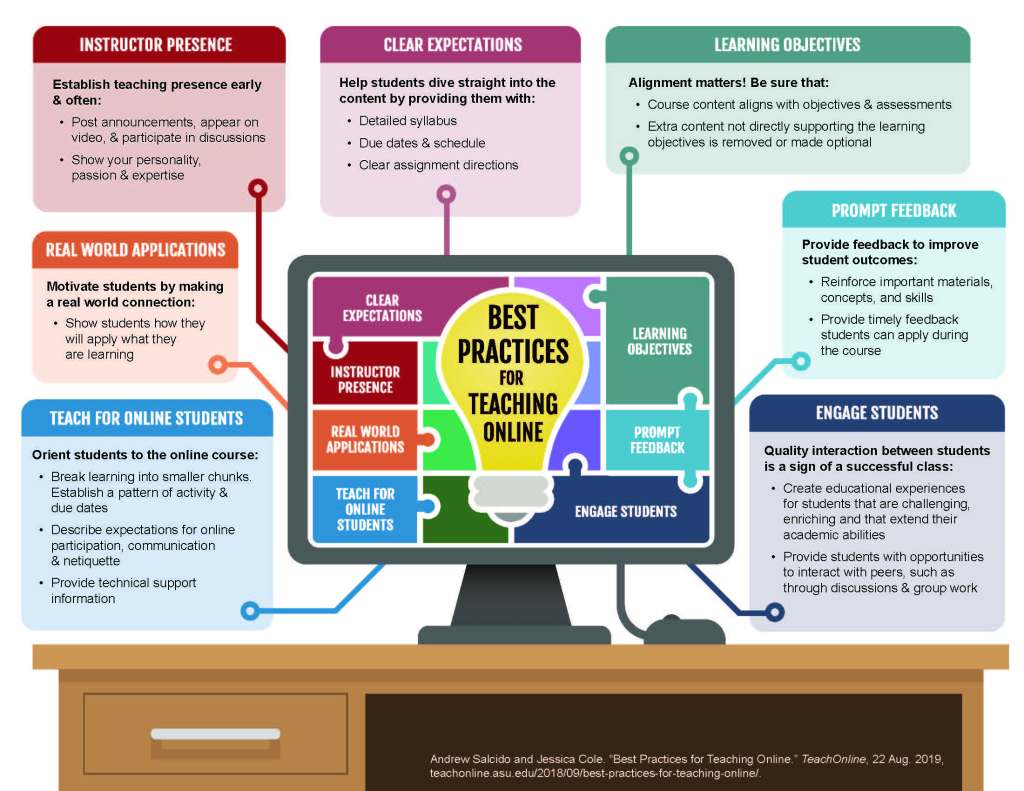
Regardless of the method of delivery, one of the defining characteristics of distance education is the separation of the student and the teacher in terms of location and time (Simonson & Zvacek, 2024). Researchers have defined best practices to help make the experiences of the remote learner equivalent to those of the in-person learner. Some of these best practices can be seen in the graphic below.

Note. From Course design: Best practices for teaching online. [Photograph], by Andrew Salcido and Jessica Cole, 10 September 2018, Arizona State University (https://teachonline.asu.edu/2018/09/best-practices-for-teaching-online/).

The Positive

One of the positive experiences I had with distance learning dealt with a recurring activity I completed with my classmates. In this particular class, we were assigned to small groups at the beginning of the online course. Toward the end of each module of the course, the small groups scheduled a convenient time for all the members to meet via Zoom and discuss the readings from the modules and share the connections we were making between the course content and our personal experiences. We then reflected on our discussions and chose part of the discussion to focus on in a blog post.

There are several reasons this specific activity was favorable to me. First, this activity promoted a student-centered learning environment. As Simonson and Zvacek point out, a student-centered learning environment “strongly promotes active learning, collaboration, mastery of course material, and student control over the learning process” (2024, p. 111). By using the Internet and Zoom as a vehicle for interactivity, we engaged in active learning as we discussed the connections we made with the course material. In their review of the literature, Johnson et al. (2023) found distance learner’s perceptions of connection to others and course content are critical factors in effective online learning.

Next,  incorporating learner autonomy and involvement is an essential component of distance education (Simonson & Zvacek, 2024). My group and I were provided autonomy in what topics we chose to focus on in our discussions as well as when we would meet via Zoom to have our discussions. These interactions helped me to appreciate how the content of the course could be applied and used in different contexts based on the varied experiences shared by all of my group members. Interaction is an important component of effective distance education. Simonson and Zvacek state that “student to student and student to content interaction are the most important” (2024, p. 78).  Other studies have also found that incorporating small groups into discussions increases participation and engages students in deeper conversations (Winger, 2022).

The second part of this activity required me to reflect on the group discussion and focus on something that resonated with me and my experiences. Again, this encouraged autonomy in my choice of what I would focus on for my blog post. I was also provided a choice of what media I would include in the blog post to enhance my post. The blog postings served as a means for me to demonstrate my understanding of the course material. This type of reflection is important in distance learning because it helps students connect with course content “through reflection that focuses on finding relationships and relevance of course content to their own life experience” (Johnson et al., 2023, p. 373).

The Negative

The only negative experience I have had with distance learning relates to feedback. In one of the first online courses I took in graduate school, we were introduced to blogs as a medium for reflection. There was a little bit of a learning curve that went along with creating a blog from scratch and then learning to incorporate different media within a blog post. There was plenty of information on the Internet that discussed how to utilize the features of the blog host I chose to use. What was frustrating was waiting to receive feedback from the instructor as to whether I was being critical enough in my blog reflections. On several occasions, I would not have feedback from a blog post before the next blog post would be due. This made me apprehensive and unsure of the quality of my work at the beginning of my first semester back in graduate school. Simonson & Zvacek (2024) reported that timely and useful feedback helps to develop stronger relationships between instructors and students. Other studies have also shown that timely, specific feedback helps learners reflect on their performance and make changes to increase their learning outcomes (Weru, 2023).

Lingering Thoughts

I am pleased to say that lag time in feedback is the only negative experience I have encountered with the distance learning courses I have completed. When reflecting on my first year in an online graduate program, I am very happy with the experiences I have had. Compared to the face-to-face program I completed for my master’s degree, I feel like I am putting in as much if not more work in this online program. I also feel like I am also spending more time reflecting and applying what I am learning in my coursework to my professional life.

References

Drexel University Online. (2017, December 18). A brief history of distance education. [Video]. YouTube. https://www.youtube.com/watch?v=6NfQDnVLZSA

Johnson, C. C., Walton, J. B., Strickler, L., & Elliott, J. B. (2023). Online teaching in K-12 education in the United States: A systematic review. Review of Educational Research, 93(3), 353–411. https://doi.org/10.3102/00346543221105550

Salcido, A., & Cole, J. (2018, September 10). Best practices for teaching online [Infographic]. Arizona State University. https://teachonline.asu.edu/2018/09/best-practices-for-teaching-online/


Simonson, M. R., & Zvacek, S. (2024). Teaching and learning at a distance: Foundations of distance education (8th ed.). Information Age Publishing, Inc.


Weru, N. (2023). The role of instructors support and feedback on the performance of online and distance Learning. International Journal of Online and Distance Learning, 4(1), 35-46. https://doi.org/10.47604/ijodl.2001


Winger, A. (2022). Deepening discussion in online learning through high-impact practices. The Quarterly Review of Distance Education, 23(3), 129–134.