Developing a Technology Plan

I recently read “Chapter 6: Planning and Budgeting” from The Technology Coordinator’s Handbook. In this chapter, the authors discuss the role of the technology coordinator when it comes to technology planning and budgeting. The technology coordinator is responsible for “articulating a vision for technology use in the school or district; establishing a clear, achievable plan for making that vision a reality; and working with administrators and the board of education to find the resources” (Frazier & Hearrington, 2017, p. 166) to implement the plan.

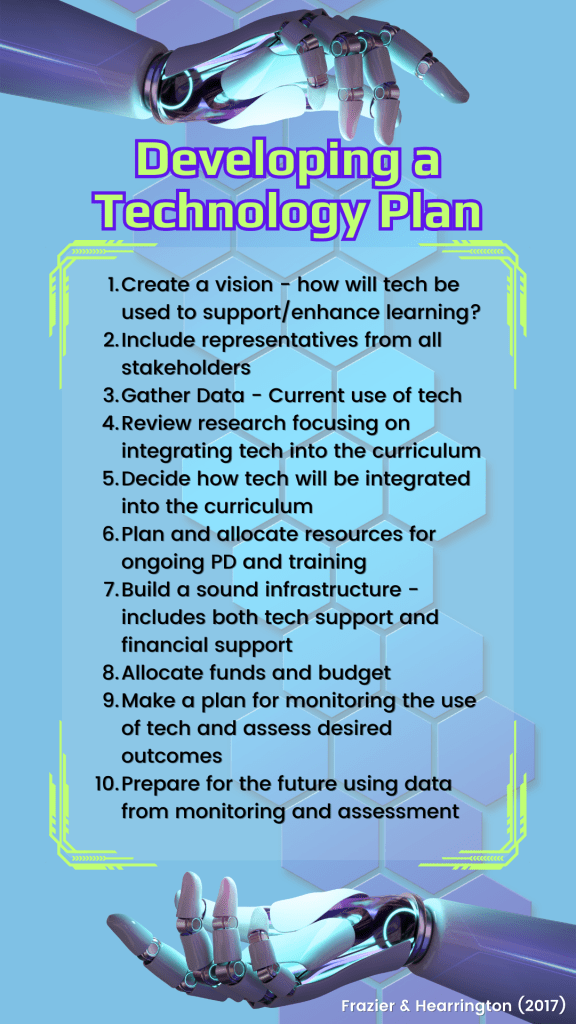
Frazier and Hearrington (2017) recommend that a technology plan contain at least the ten elements displayed in the infographic to the right. From the infographic, one can see that a solid technology plan does not just focus on equipment. The plan must consider the current state of technology in the district, where the district would like to be in three to five years, a list of resources needed to succeed, and an implementation guide when these resources are in place.
Workflow Suggestions

The authors propose the following workflow when starting to review and develop a technology plan (Frazier, 2019; Frazier & Hearrington, 2017).

  1. Create a SWOT (Strengths, Weaknesses, Opportunities, and Threats) Analysis document incorporating the International Society of Educational Technology’s (ISTE) Essential Conditions for Effective Tech Use in Schools (ISTE, 2024).
  2. Identify the SWOTs for each of the Essential Conditions by considering the condition from multiple perspectives. Be sure to gather evidence to support the identified statements.
  3. Create a TOWS matrix for each of the Essential Conditions using the SWOTs identified in the previous step.
  4. Use the TOWS matrix to consider the following.
    • How can strengths be used to maximize opportunities?
    • How can strengths be used to minimize identified threats?
    • How can identified weaknesses be minimized using opportunities?
    • How can weaknesses be minimized and identifiable threats avoided?
  5. Let stakeholders vote to prioritize strategies and decide which should be considered in the technology plan.

Critical Areas to Remember

After reading the text, I engaged in a discussion with my colleagues regarding the process of planning and budgeting for technology in schools. Based on my reading and our reflection, I came away with the two important elements that are critical to not overlook: professional development and equitable access.

When developing a technology plan, it can be easy to overlook “the allocation of resources for professional development and training” (Frazier & Hearrington, 2017, p. 172). Teachers need to learn how to use technology and how it can be used to enhance student learning by developing twenty-first-century skills. Ireh (2010) views this as the most critical budget item since a district is likely to achieve the goals outlined in its technology plan if teachers and staff do not know how to use the technology they are provided. Some districts even budget for Instructional Technology Coaches in each building to support teachers and encourage continued growth in ways that technology can support student learning (O’Shea & Trainin, 2021).

Another critical element to consider in planning is digital equity. In particular, Internet access at home. The sudden shift to online learning when the COVID-19 pandemic hit made clear that not all students had equitable Internet access at home (O’Shea & Trainin, 2021; Salsbury & Hansen, 2022). Many schools provided students with hot spots to use so they could access the Internet and attend online classes. The U.S. Congress allocated money to fund the Affordable Connectivity Program which allowed families that qualified access to free or reduced-cost Internet. Sadly, schools are no longer receiving the extra funds to pay for hot spots, and the Affordable Connectivity Program stopped accepting applications on February 7, 2024. Barring any additional funding from Congress, the program is expected to run out of money in April 2024 (Federal Communications Commission, 2024).

Note. From Biden announces how billions for expanding broadband internet are being distributed [Video], by News4JAXLocal, 26 June 2023, YouTube (https://www.youtube.com/watch?v=s5wrXbSemSk)

President Bidden recently announced the Internet for All initiative. While the program is offering each state money to improve their broadband infrastructure, there is still the issue of affordability. From the Internet for All website, it is unclear if any money will be available to help those families living in poverty get affordable access to broadband Internet. Often, teachers may not know whether or not students have access to the Internet at home. Students and parents may be embarrassed to reveal that they cannot afford Internet access, or they may not know how to ask for assistance. Providing students with devices does not do much good if they cannot use them to access information while the students are at home. Researching available programs as they become available will be critical for ensuring that all students can access the Internet from home and have equal access to online learning.

References

Federal Communications Commission. (2024). Affordable connectivity program. https://www.fcc.gov/acp

Frazier, M. (2019, January 30). ISTE 5 tips to get started with technology planning. International Society for Technology in Education. https://iste.org/blog/5-tips-to-get-started-with-technology-planning

Frazier, M., & Hearrington, D. (2017). The technology coordinator’s handbook (3rd ed.). International Society for Technology in Education.

Ireh, M. (2010). Budgeting and funding school technology: Essential considerations. School Business Affairs, 76(7), 18–20.

Lennox, J., Reuge, N., & Benavides, F. (2021). UNICEF’s lessons learned from the education response to the COVID-19 crisis and reflections on the implications for education policy. International Journal of Educational Development, 85. https://doi.org/10.1016/j.ijedudev.2021.102429

News4JAX The Local Station. (2023, June 26). Biden announces how billions for expanding broadband internet are being distributed [Video]. YouTube. https://www.youtube.com/watch?v=s5wrXbSemSk

O’Shea, C. M., & Trainin, G. (2021). How did we get here? One district’s approach to device assisted learning technology implementation. Journal of School Administration Research and Development, 6(2), 99–106.

Salsbury, M., & Hansen, M. A. (2022). Bridging the digital divide: Wi-Fi hot spots as a means of digital equity. Portal: Libraries and the Academy, 22(1), 199–219.

Tomer, A., Fishbane, L., Siefer, A., & Callahan, B. (2020, February 27). Digital prosperity: How broadband can deliver health and equity to all communities. Brookings Institution. https://www.brookings.edu/articles/digital-prosperity-how-broadband-can-deliver-health-and-equity-to-all-communities/#:~:text=Because%20broadband’s%20applications%20are%20so,collective%20health%20and%20equity%20outcomes.

United States Government. (2024). Internet for all. https://www.internetforall.gov/

Empowering Educators: Designing Technology-Infused Lessons

As a relatively new Instructional Tech Specialist at my school, I am always mindful of modeling best practices for my teachers when it comes to integrating technology into their lessons. As part of a graduate course I am taking, I am reading the Technology Coordinator’s Handbook. In Chapter 2 of the text, the authors discuss one role of a technology coordinator as supporting teaching and learning with technology (TLT). One of the ways that technology coordinators achieve this is by providing teachers professional development on instructional design processes that include the appropriate integration of technology (Frazier & Hearrington, 2017). The Analysis, Design, Development, Implementation, and Evaluation (ADDIE) Design Model was mentioned as a tool for both instructional planning and professional development. Since I had never heard of the ADDIE Model before, I decided to dig a little deeper to see how I might be able to utilize it in my role as an Instructional Tech Specialist.

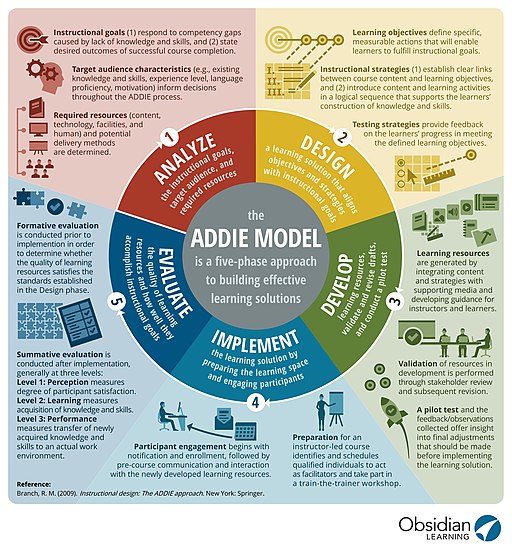
The ADDIE Model

Note. From ADDIE Model Instruksional. [Photograph], by Krisna Kristiandi Hartono, 2018, Wikimedia Commons (https://commons.wikimedia.org/wiki/File:ADDIE_MODEL_INSTRUKSIONAL.jpg).

Here is a brief description of each stage of the ADDIE Model (Lu & Sides, 2022; Yeh & Tseng, 2019).

ANALYSIS STAGE

  • Identify instructional problem
  • Establish instructional goals
  • Analyze goals and subordinate skills
  • Identify the needs of students: What do they already know? What do they need to know?
  • Identify the best learning environment

DESIGN STAGE

  • Establish behavioral objectives and assessment instruments
  • “Translate subordinate skills into measurable performance objectives and design parallel assessments” (Lu & Sides, 2022)
  • Identify effective instructional strategies
  • Select media and technological tools that support the instructional strategies and activities

DEVELOPMENT STAGE

  • Create the instructional materials to be used based on the outline from the Design phase
  • Check that materials and activities are aligned to the objectives

IMPLEMENTATION STAGE

  • Teach the lesson
  • Use formative assessments to collect feedback from students so adjustments can be made in the moment

EVALUATION STAGE

  • Use data from formative assessments to analyze and improve the design of the lesson
  • Use data from summative assessments to assess students’ mastery of instructional goals
Note. From ADDIE Model of Instructional Design [Video], by NeuroFeedSnack, 22 July 2018, YouTube (https://www.youtube.com/watch?v=JxShaB4R0d8)

TPACK

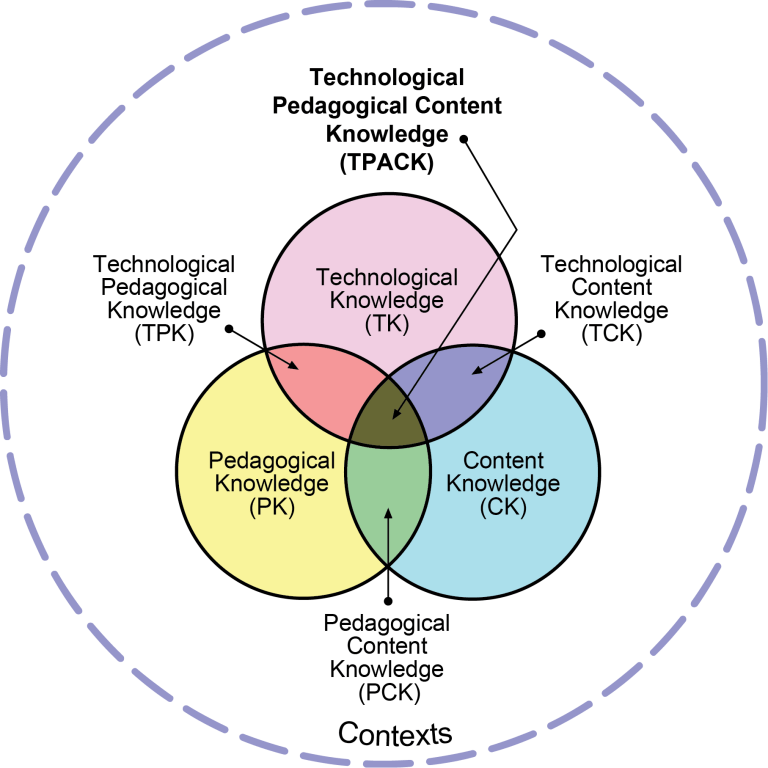
Note. From Using the TPACK Image. [Photograph], by Matthew Koehler, 2012, TPACK.ORG (https://matt-koehler.com/tpack2/using-the-tpack-image/).

Our students live in a technology-rich world. They will be required to utilize technology in some way in their future careers. This means that we must equip students with the technological skills they will need. As a result, the knowledge teachers must know extends beyond content and pedagogical knowledge. They must also also have technological knowledge. The Technological Pedagogical Content Knowledge (TPACK) framework identifies “the nature of knowledge required by teachers for technology integration in their teaching, while addressing the complex, multifaceted and situated nature of teacher knowledge” (Koehler, September 24, 2012).

When considering the technological, pedagogical, and content knowledge needed for successful technology integration, the Design stage of the ADDIE model has been shown to enhance teachers Technological Knowledge (TK), Technological Content Knowledge (TCK), and Technological Pedagogical Knowledge (TPK) (Yeh & Tseng, 2019, p. 98).

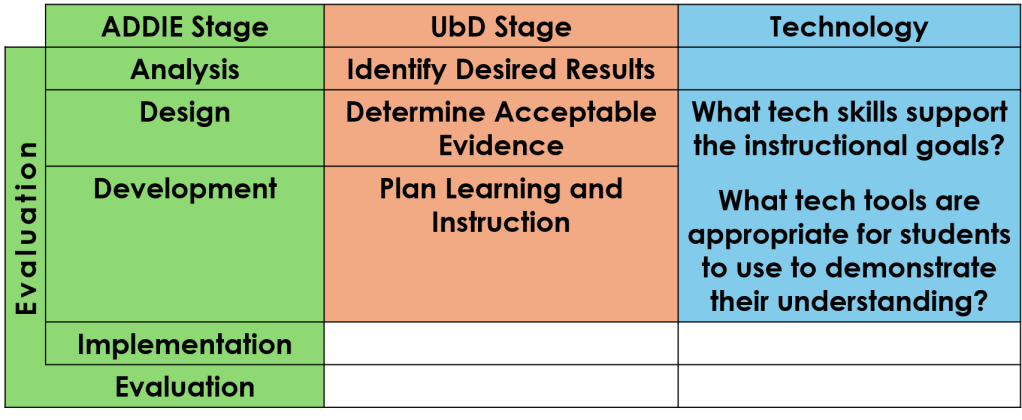
As I reflected on the ADDIE Model, I noticed that it was similar to the Understanding by Design (UbD) Framework in that both models start with the end in mind before planning how to reach the instructional goals of the lesson. I am a big proponent of the UbD Framework for designing effective instruction. In this framework, lesson planning occurs in three stages: 1) identify desired results, 2) determine acceptable evidence, and 3) plan learning experiences and instruction (Wiggins & McTighe, 2005).

Some researchers have proposed a mashup of the ADDIE Model and UbD Framework to help teachers as they plan their instruction (Schwieger & Ladwig, 2021; Setiawan, 2022). The visual below represents how the stages align and overlap between the two instructional design models.

It should be noted that this model incorporates the cyclical view of the ADDIE Model with evaluation occurring not only at the end of instruction but also during the Analysis, Design, Development, and Implementation phases.

Lingering Thoughts

I am always looking for ways to help my teachers be more reflective and intentional with the technology they use with their students. We are currently in the process of reviewing the ISTE Standards for Students to see how they align with the learning targets in our core classes. As we begin to review and align the standards, this mashup model of the ADDIE and UbD Frameworks might be useful in helping teachers think critically about the learning activities they design and how students might be able to demonstrate their understanding through the use of technology. In particular, paying attention to specific tech skills students can use to demonstrate their understanding while also supporting the ISTE Standards for Students.

References

Amatya, G. (2022). Let’s talk ADDIE: It still matters. eLearning Industry. https://elearningindustry.com/lets-talk-addie-it-still-matters

Frazier, M., & Hearrington, D. (2017). The technology coordinator’s handbook (3rd ed.). International Society for Technology in Education.

Koehler, M. (2017, June 9). Tpack explained. TPACK.ORG. https://matt-koehler.com/tpack2/tpack-explained/

Kurt, S. (2018, December 16). Addie model: Instructional design. Educational Technology. https://educationaltechnology.net/the-addie-model-instructional-design/

Lu, L., & Sides, M. L. (2022). Instructional design for effective teaching: The application of ADDIE model in a college reading lesson. Practitioner to Practitioner, 11(1), 4-12.

NeuroFeedSnack. (2018, July 22). ADDIE model of instructional design [Video]. YouTube. https://www.youtube.com/watch?v=JxShaB4R0d8

Power, R. (2023). Everyday instructional design: A practical resource for educators and instructional designers. Power Learning Solutions. https://pressbooks.pub/everydayid/

Schieger, D., & Ladwig, C. (2021). Using a modified understanding by design framework to incorporate social media tools in the management information systems curriculum for generation Y and Z students. Journal of Information Systems Education, 32(3), 166-175.

Setiwan, A. A. (2022). Instructional design: Teaching algebraic equations to grade 8 students with involvement of mathematical reasoning in Cambridge IGCSE curriculum. Journal of Instructional Mathematics, 3(1), 1-15.

Wiggins, G., & McTighe, J. (2005). Understanding by design (2nd ed.). Association for Supervision and Curriculum Development.

Yeh, H. C., & Tseng, S. S. (2019). Using the ADDIE model to nurture the development of teachers’ CALL professional knowledge. Journal of Educational Technology & Society, 22(3), 88-100.

The Case for the Use of AI in the World of Education

I recently finished reading AI for Educators: Learning Strategies, Teacher Efficiencies, and a Vision for an Artificial Intelligence Future by Matt Miller as part of a professional book study. The book offers good suggestions for how teachers can utilize artificial intelligence (AI) tools to help with instruction and administrative tasks. I chose this book because many of my colleagues have concerns and questions about the use of AI tools in the classroom. What follows are my thoughts and findings from my research.

AI is Already Here

Like it or not, artificial intelligence (AI) has become a part of our daily lives. We have seen the rise in the use of personal assistants, such as Siri, Google Assistant, and Amazon Alexa, which allow users to set reminders, send messages, play music, and control smart home devices. Social media now uses AI algorithms to determine user preferences and behavior, suggest relevant material, and customize the user experience. AI algorithms are also used by social media companies to help identify and eliminate fake news, hate speech, and other harmful content. Many businesses are using virtual assistants and chatbots powered by AI to offer 24/7 customer services, such as tracking orders and processing returns. E-commerce sites, like Amazon, provide customers with product recommendations based on their search queries and browsing histories. AI has also made its way into healthcare with patient monitoring, medication research, and medical imaging analysis. For example, Merative uses AI to analyze medical images and assist doctors with making diagnoses. The medical app Ada uses AI to help users identify symptoms and connect with healthcare professionals.

Note. From Using artificial intelligence in radiology clinical practice [Video], by Mayo Clinic, n.d., YouTube (https://www.youtube.com/watch?v=dCDuMyzWS8Q)

The Role of AI in Education

According to Chen et al. (2020), the use of AI “in education has had a major impact, including improved efficiency, global learning, customized/personalized learning, smarter content, and improved effectiveness and efficiency in education administration among others” (p. 75265). Some uses of AI in instruction include interactive learning environments (ILEs) which manage student performance and feedback exchanges between students and teachers. Many schools currently use intelligent tutoring systems like MATHia for mathematics, ClearFLuency for reading, World Language Immersion for learning a foreign language. There are also adaptive learning systems such as Pearson’s Interactive Labs for science. AI can also support teachers and students through grading and feedback. Examples of some of these applications include Grammarly (grammar check), Ecree (provides immediate feedback and guidance when writing), and TurnItIn (streamlines the grading and feedback process).

AI can also help teachers plan instruction. Miller (2023) offers the following ways that AI assistants, like ChatGPT, can be used to increase teacher efficiency: 

  • Create review content, questions, and activities
  • Provide student feedback for written work
  • Write report card comments or help compose parent emails
  • Summarize texts
  • Create leveled text sets
  • Generate prompts and questions to facilitate discussions
  • Create a virtual lab
  • Create presentation slides 
  • Write content for IEPs – help with writing rationales for goals
  • Writing letters of recommendation

In summary, AI can be used to automate and expedite administrative tasks for both schools and teachers by grading homework and evaluating essays which frees up more time for teachers to work with students one-on-one. Through the use of AI, students have “richer learning experience[s] because AI uses machine learning to assess capabilities and needs, and subsequently, with the findings of such analysis, develop and disseminate personalized or customized content, which ensures higher uptake and retention, thereby improving learning” (Chen et al., 2020, p. 75276). AI can also help students who are at a disadvantage when compared to their peers. This might include students who have no support system at home to help them proofread their papers or look over their homework.

Concerns About the Use of AI in Education

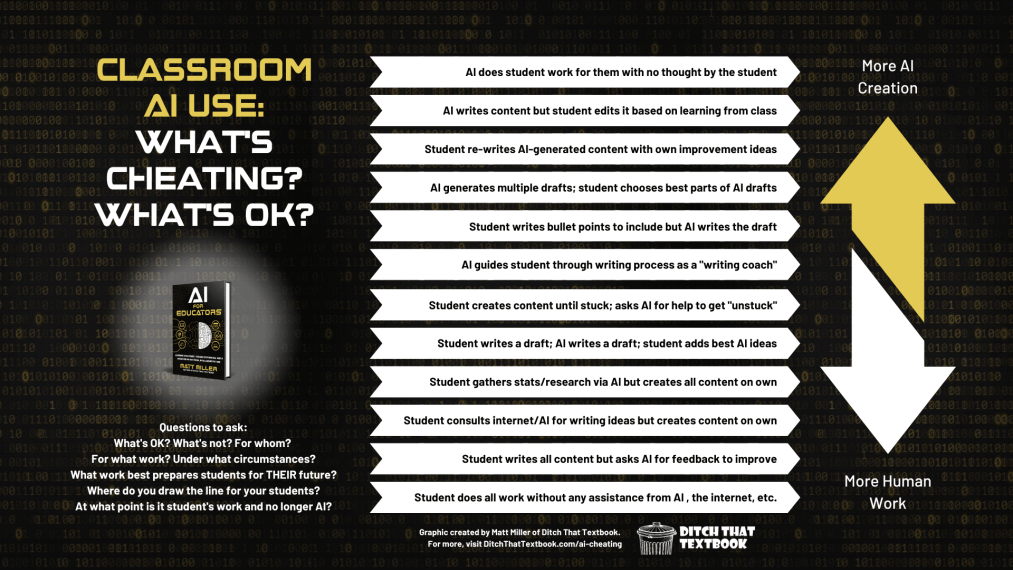
One of the biggest concerns regarding the use of AI in education is that some students may use it to engage in academic dishonesty. Some would also include plagiarism here, but this is a grey area. Miller (2022) states that work created by AI legally “isn’t intellectual property owned by anyone” (p. 83). Miller also feels that society’s definition of “cheating” will change in response to AI becoming more prominent in our work and personal lives. This is why it is imperative that we teach students how to ethically and responsibly use AI as a tool and combine it with their human skills.

Note. From Classroom AI Use: What’s Cheating? What’s OK? [Photograph], by Matt Miller, 2023, Ditch that Textbook (https://ditchthattextbook.com/ai-cheating/).

Another big concern about the use of AI by students deals with data. Some of the questions we need to consider when we use AI tools are: what data is being collected, and who has access to this data? If data is being collected, we need to ensure that privacy laws are being followed (Miller, 2023). Another data concern deals with accuracy and bias.

A final concern surrounding AI is that it might one day replace teachers in the classroom. Many argue that this is unlikely to happen because AI cannot connect with students in the classroom the way a human teacher can because it is not capable of feeling emotions. This implies that AI would be “incapable of truly empathizing with its students in the classroom … or reading the mood of the class when teaching and adapting its performance accordingly” (Guigerme, 2019, p. 52). AI also would not be able to utilize common classroom management techniques employed by human teachers, such as the use of tone of voice, facial expressions or looks, and physical proximity to help redirect off-task behaviors. In their study, Frey and Osborne (2017), concluded that teaching is among the hardest professions to automate with AI because of its focus on social-emotional skills. 

While concerns do exist, Chen et al. (2020) found in their review of the literature that the “benefits of AI to learning supersede the challenges” (p. 75275). These benefits along with the increasing use of AI in the world mean we must teach our students how to use AI responsibly and ethically.

References

Chen, L., Chen, P., & Lin, Z. (2020). Artificial Intelligence in education: A Review. IEEE Access, 8, 75264–75278. https://doi.org/10.1109/access.2020.2988510

 Frey, C. B., & Osborne, M. A. (2017). The future of employment: How susceptible are jobs to computerisation? Technological Forecasting and Social Change, 114, 254–280. https://doi.org/10.1016/j.techfore.2016.08.019

Guilherme, A. (2019). AI and education: The importance of teacher and student relations. AI & SOCIETY, 34, 47–54. https://doi.org/10.1007/s00146-017-0693-8

Miller, M. (2023). AI for educators: Learning strategies, teacher efficiencies, and a vision for an artificial intelligence future. Ditch that Textbook.

Miller, M. (2023). Classroom AI use: What’s cheating? What’s OK? [Photograph]. Ditch that Textbook. https://ditchthattextbook.com/ai-cheating/

Mayo Clinic. (n.d.). Using artificial intelligence in radiology clinical practice [Video]. YouTube. https://www.youtube.com/watch?v=dCDuMyzWS8Q

Analyzing the Digital Arguments of a Social Media Post

This last week I read Chapter 6 of Argument in the Real World by Turner and Hicks. This chapter focused on how users can interact with discussions on social media in a responsible way without spreading or sharing misinformation. With the widespread posting of misinformation via Internet platforms like social media, we must be vigilant in evaluating and questioning the validity of the information we encounter (Khan & Idris, 2019). Turner and Hicks (2011) offer the “MINDFUL heuristic” (p. 108) to help us do just that. MINDFUL helps us remember to always: MONITOR what we read and write; IDENTIFY the main claim of what we read or write; NOTE what evidence is used to support claims; DETERMINE if the evidence clearly supports the claim and what the mindset of the author is; FACTS – Identify if the evidence is based on facts, opinions, or both; UNDERSTAND opposing views to the argument; and LEVERAGE how others will take your response (Turner & Hicks, 2011, pp. 109-110).

The State Department of Education of California has recently undertaken the daunting task of rewriting the math framework for the state.  Several prominent mathematicians have criticized the framework. Much of the criticism revolved around the citing of research that was not peer-reviewed in the document as well as some research that had opposite conclusions to what the framework document reports. The other big criticism is the introduction of new courses that would substitute for a second year of algebra. Many of these proposed courses are labeled as “data science,” when in reality they would be more appropriately named “data literacy.” Brian Conrad, a math professor and director of undergraduate studies in math at Sanford University, offers a helpful analogy to drive home his concern about these substitute courses for a second year of algebra. Conrad (2023) states “…much as music-appreciation courses won’t teach you how to play a piano, data literacy is not data science.”

Proponents of the new courses claim that the new courses will offer better outcomes for typically underrepresented groups in mathematics, for example, girls and students of color. Conrad argues that this will have the opposite effect by closing off access to careers in quantitative fields requiring the foundational knowledge and skills learned in Algebra II. The framework is misleading students and parents into believing that the substitute data science courses cover the same skills learned in Algebra II that will set students up for success in calculus in college. Without these skills, students may not be able to successfully navigate the quantitative courses at college that rely heavily on calculus.

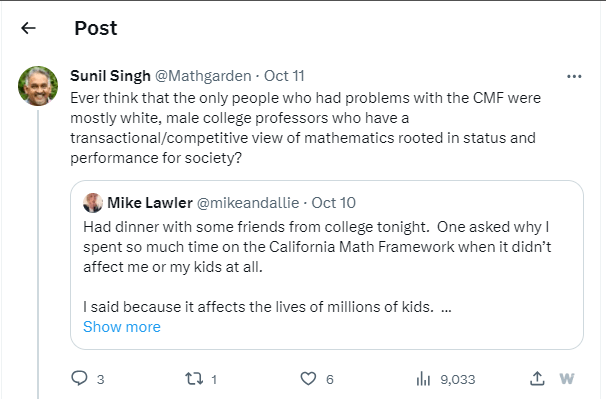
I chose a discussion that occurred on Twitter between Dr. Jelani Nelson, an Engineering and Computer Science professor at UC Berkeley, and Sunil Singh, a former mathematics and physics teacher (see below). Singh starts off the conversation with a claim that seems to criticize a post made by another person, Mike Lawler. Singh’s main claim – actually more of an opinion – is that the only people who take issue with the California Mathematics Framework (CMF) are white, male college professors who view math from a competitive perspective with only the prestigious being able to succeed in the field (Singh, 2023). Singh presents no evidence to support his claim. Lawler is a white, male and also a former math professor.

Note. From Ever think that the only people who had problems with the CMF were mostly white, male college professors who have [Tweet], by Sunil Singh, 2023, Twitter ( https://twitter.com/minilek/status/1712120663643971822).

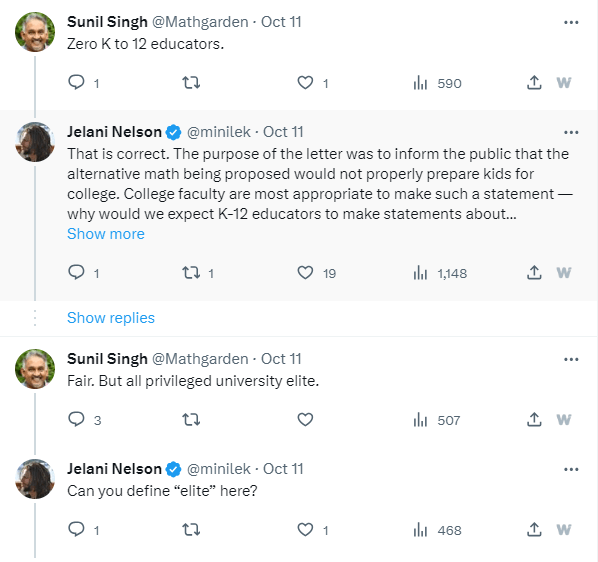
Dr. Nelson offers a rebuttal (see below) by stating that Singh is incorrect in his claim that the only people who have voiced concerns over the CMF are white, male college professors (Nelson, 2023). Dr. Nelson provides evidence in the form of a public open letter written by faculty members from 4-year colleges and universities across California. He provides a direct link to the open letter and also identifies professors who are not male or white. Dr. Nelson also offers another link to an Op-Ed piece written by two females to further support his counterclaim against Singh.

Note. From This is incorrect. Perhaps the most significant pushback by university faculty is this letter: https://sites.google.com/view/mathindatamatters/home There are 8 authors:  Moses [Tweet], by Jelani Nelson, 2023, Twitter ( https://twitter.com/minilek/status/1712120663643971822).

Singh responds to Dr. Nelson’s counterargument with the claim that there were no K-12 educators listed in the evidence presented (2023). This had nothing to do with his original claim that only white, male college professors took issue with the CMF. Dr. Nelson agreed with Singh about there being no K-12 educators involved in the open letter he presented as evidence. He follows that up with his own argument that the critique made in the open letter was that the new CMF does not prepare all students for college (Nelson, 2023). Dr. Nelson argues that college professors would be better judges of whether students will be prepared for college since they work at those colleges that future students will seek admission to. Singh responds to Nelson stating that the professors listed in the open letter are all “privileged university elite” (Singh, 2023). Again, this is more of Singh’s opinion and not supported by any evidence. 

Note. From Zero K to 12 educators [Tweet], by Sunil Singh, 2023, Twitter ( https://twitter.com/minilek/status/1712120663643971822).

If Singh’s ultimate goal was to push out a narrative that a group of white, male professors are against the CMF as a way of keeping the status quo, he has not been very persuasive. His opinions are not backed up by any evidence to support his beliefs. On the other hand, Dr. Nelson does a great job of utilizing some of the digital writing skills outlined by Turner and Hicks (2011). Namely, Dr. Nelson’s claim was easy to understand. He offered evidence to support why Singh’s statement was incorrect in the form of hyperlinks that took the reader directly to the artifact and also served as a form of in-text citation.

The website housing the open letter has the names of eight faculty members from six different colleges and universities in California as well as the signatures of professors from other universities and colleges in the state. The signatories list their names, title, and the university/college with which they are affiliated. I found it easy to search and verify that these professionals were actually affiliated with these institutions and what their current roles were. With regard to the open letter itself, I liked that the authors used a Google Site to post the letter. Within the letter, hyperlinks were used to connect to the CMF document that was being critiqued. Other hyperlinks were used as a form of evidence to support the author’s concerns regarding the CMF document.

With the amount of information available on the Internet, users will eventually encounter biased and inaccurate information. Therefore, it is important that consumers of this information be able to “carefully filter, evaluate, and verify information to separate reliable content from wrong information” (Khan & Idris, 2019). Looking at the social media exchange I examined, it also requires the reader to be able to separate opinions from facts. With the way we consume information today, it is imperative that we all do our part to stop the spread of misinformation.

References

Conrad, B. (2023, October 2). California’s math misadventure is about to go national. The Atlantic. https://www.theatlantic.com/ideas/archive/2023/10/california-math-framework-algebra/675509/

Khan, M. L., & Idris, I. K. (2019). Recognise misinformation and verify before sharing: A reasoned action and information literacy perspective. Behaviour & Information Technology, 38(12), 1194-1212. https://doi.org/10.1080/0144929X.2019.1578828

Nelson, J. [@minilek]. (2023, October 11). This is incorrect. Perhaps the most significant pushback by university faculty is this letter: https://sites.google.com/view/mathindatamatters/home There are 8 authors:  Moses [Tweet]. Twitter. https://twitter.com/minilek/status/1712120663643971822

Nelson, J. [@minilek]. (2023, October 11). That is correct. The purpose of the letter was to inform the public that the alternative math being proposed would [Tweet]. Twitter. https://twitter.com/minilek/status/1712120663643971822

Singh, S. [@Mathgarden]. (2023, October 11). Ever think that the only people who had problems with the CMF were mostly white, male college professors who have [Tweet]. Twitter. https://twitter.com/minilek/status/1712120663643971822

Singh, S. [@Mathgarden]. (2023, October 11). Fair. But all privileged university elite [Tweet]. Twitter. https://twitter.com/minilek/status/1712120663643971822

Singh, S. [@Mathgarden]. (2023, October 11). Zero K to 12 educators [Tweet]. Twitter. https://twitter.com/minilek/status/1712120663643971822

Turner, K. H., & Hicks, T. (2017). Argument in the real world: Teaching adolescents to read and write digital texts.

Creating a Video Text: Being a Good Digital Citizen

After reading Chapter 5 of Argument in the Real World, I took the information in the text about creating arguments in the video and used it to revise an introductory video I had created. With Digital Citizenship Week coming up this month, I decided to incorporate this into my video text. I have noticed that the students at my school are good about citing text resources that they use in their writing, but they are not so good about citing media sources such as images or videos. My goal with this project was to create a video text to quickly remind students of the importance of citing the media elements they use in their projects. Here is the video that I created.

Note. From Video text: Creative Commons [Video], by Kevin Wolfe-Hughes, 2023, YouTube (https://youtu.be/Z-x5B05aRWw).

Digital Citizenship

Our students use technology every day. While we do our best to keep our students safe, it is important that students take ownership of their ethical and legal use of technology (Hollandsworth, Dowdy, & Donovan, 2011). Digital citizenship is an important concept that can easily be modeled in any classroom by any teacher. The International Society for Technology in Education (ISTE) has a “Digital Citizen” standard that states that students should be able to “recognize the rights, responsibilities and opportunities of living, learning and working in an interconnected world, and they act and model digital citizenship in ways that are safe, legal and ethical” (ISTE, 2023). “Intellectual property” falls under this standard. With respect to “Intellectual Property,” students should be able to “demonstrate an understanding of and respect for the rights and obligations of using and sharing intellectual property” (ISTE, 2003).

Hollandsworth, Dowdy, and Donovan (2011) provide a good analogy for digital citizenship. The authors state that “digital citizenship can be compared to American citizenship in that all digital citizens have the same basic rights: to privacy, free speech, and creative work rights” (p. 41). They also state that “students should also understand that when something is created it belongs to the creator” (Hollandsworth, Dowdy, & Donovan, 2011, p. 41). As a result, it is imperative that we as educators help students understand how to conduct themselves in an ethical and responsible manner when they are online.

Note. From Digital Citizen 2c: Intellectual Property [Video], by ITSE, n.d., YouTube (https://youtu.be/cOD-WNdsPBA?list=PL6aVN_9hcQEH6D0zMdylQbDkSrV-MNOwD).

Creating the Video Text

More components and planning went into this video text when compared to the original video I made. Based on the craft elements mentioned by Turner and Hicks (2017), I wrote a script and outline. I utilized a combination of still images I created in Canva along with a video I made. The still images utilized text and images to emphasize what was being narrated. I chose to use a still image of me since most of the students know who I am, and I really wanted the focus to be on digital citizenship.

When creating the video, I wanted to show students how quick and easy it is to give attribution to resources that are found using the Creative Commons search engine. I kept the video clean and simple with basic transitions between the images and the video to help underscore how easy it is to use. By using the video, I was also able to show students how digital writing allows them the opportunity to use hyperlinks with images. This was mentioned in the text as a way to take viewers directly to the source of an image with an attribution license that allows others to use the image (Turner & Hicks, 2017). The video also illustrates how easy it is to give attribution to images by copying the information from Creative Commons directly into their reference list.

Once the video was complete, I merged all of the elements together using iMovie. This program allowed me to add basic transitions when moving from picture to picture and then to the video. I was also able to add a voice-over component to the portion of the video where I used the still images. The biggest challenge I experienced was getting the running time of the video down to the bare minimum. Overall, the process was pretty easy with the tools I had at my disposal.

References

Hollandsworth, R., Dowdy, L., & Donovan, J. (2011). Digital citizenship in K-12: It takes a village. TechTrends: Linking Research & Practice to Improve Learning, 55(4), 37–47. https://doi.org/10.1007/s11528-011-0510-z

International Society for Technology Education. (n.d.). Digital citizen 2c: Intellectual property (ITSE standards for students) [Video]. YouTube. https://youtu.be/cOD-WNdsPBA?list=PL6aVN_9hcQEH6D0zMdylQbDkSrV-MNOwD

International Society for Technology Education. (2023). ISTE standards: For Students. Retrieved October 9, 2023, from https://iste.org/standards/students

Turner, K. H., & Hicks, T. (2017). Argument in the real world: Teaching adolescents to read and write digital texts.

Visual Persuasion: Crafting Compelling Infographics

Note. From What makes a good infographic? [Photograph], by Daniel Zeevi, 2013, Flickr ( https://flic.kr/p/dSxX4V). CC BY-ND 2.0.

I just finished reading Chapter 4 of Argument in the Real World by Kristen Hawley Turner and Troy Hicks. In this chapter, the authors discuss using infographics as a form of argument. Abilock and Williams (2014) define an infographic as “a claim expressed through visual metaphor, conveying the creator’s fresh understanding of relationships, expressed through a judicious selection and arrangement of visuals, evidence, and text acquired during inquiry research within a discipline” (p. 47). Infographics are a powerful tool for making arguments and worth teaching students how to use (Turner & Hicks, 2017).

Infographics are very effective at presenting information quickly and efficiently by leveraging brain science.  NeoMam Studios (n.d.) has a site, 13 Reasons Why Your Brain Craves Infographics, illustrating why infographics can be so helpful.

Common Themes in Infographics

In their examination of infographics, Hawley and Turner (2017) identified three universal themes when it comes to infographics. First, the data in the infographic must tell a story. Second, the data must come from reliable sources. Finally, the infographic should be visually appealing and easy to share.

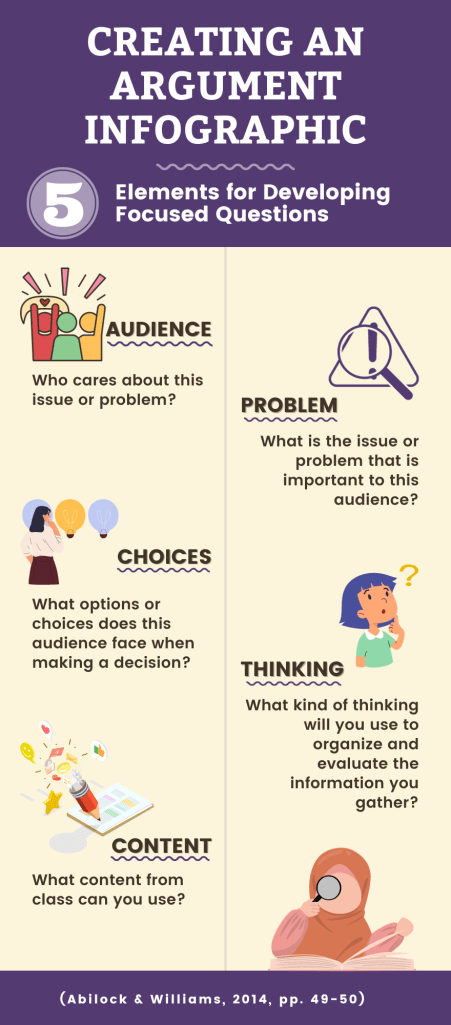
Good argument infographics start with inquiry. Students’ inquiry begins with questions. Students might typically start with the K-W-L strategy to formulate questions (Ogle, 1986) to orient their inquiry. Abilock and Williams (2014) argue that this is not enough. To be relevant, students must consider the infographic’s audience and purpose. Abilock and Williams propose five elements that students’ questions should address. Those are outlined in the infographic to the right.

Application in the Math Classroom

Hawley and Turner (2017) share the following suggestion as a possible classroom activity using infographics. “Identify a local issue of importance to the school or community. Design a survey and distribute it through social media. Using the data that is collected, have students take a stand and create infographics to share” (p. 80). This type of activity could be used to address the Alabama Content Standards for Mathematics. Under the Data Analysis, Statistics, and Probability content area, one of the focus areas states that “data arise from a context and come in two types: quantitative (continuous or discrete) and categorical. Technology can be used to “clean” and organize data, including very large data sets, into a useful and manageable structure–a first step in any analysis of data” (Alabama State Department of Education, 2019, p. 136).

I could see this being used with an issue my school is looking into this year. We are considering revising our bell schedules for the 2024-2025 school year. Many students would like the opportunity to take more electives than they currently do. Teachers would like to see some type of study hall built into the school day to assist students who need extra help. This provides an excellent real-world scenario of where mathematics can be applied to help answer questions. We could involve students in this real-world problem. Students could help design a Google Form to collect the preferences of students, teachers, and parents. After collecting the information, students could analyze and organize the data by creating infographics to help share the collected data with all stakeholders in our school community. Each grade level could analyze their data and the school as a whole.

References

Abilock, D., & Williams, C. (2014). Recipe for an Infographic. Knowledge Quest43(2), 46–55.

Alabama State Department of Education. (2019). 2019 Alabama course of study: Mathematics.

Ogle, D. M. (1986). K-W-L: A teaching model that develops active reading of expository text. Reading Teacher, 39(6), 564–570.

Turner, K. H., & Hicks, T. (2017). Argument in the real world: Teaching adolescents to read and write digital texts.

Zeevi, D. (2013). What makes a good infographic? [Photograph]. Flickr. https://flic.kr/p/dSxX4V

Unlocking Mathematical Minds: Harnessing the Power of Blogging for Critical Thinking

Currently, I am reading Argument in the Real World by Kristen Hawley Turner and Troy Hicks. The authors argue for using social media to help students develop their skills in writing digital arguments. These skills are necessary to see students move from consuming content online to creating their own content. Creating content requires students to be able to express their ideas clearly and be able to defend them.

Turner and Hicks (2017) state that “practicing the moves of argument–with both print and digital writing–will help students become more proficient as critical thinkers” (p. 14). Some of the “moves” that Hawley Turner and Hicks discuss in their book include: using images to both make claims and provide evidence, using evidence to support claims, formulating counterclaims, and choosing design elements to reinforce the ideas a writer is trying to communicate. As a former math teacher, this made me wonder how writing, digital writing in particular, could be used to promote critical thinking in the math classroom. How might a digital medium like blogging be used to develop critical thinking skills? What does research say about the role of writing in the math classroom?

Current Standards

The National Council of Teachers of Mathematics (NCTM) views communication as integral to learning mathematics. NCTM (2000, p. 60) states in its Communication Standard that

Instructional programs from prekindergarten through grade 12 should enable all students to–

  • organize and consolidate their mathematical thinking through communication;
  • communicate their mathematical thinking coherently and clearly to peers, teachers, and others;
  • analyze and evaluate the mathematical thinking and strategies of others;
  • use the language of mathematics to express mathematical ideas precisely.

The Common Core State Standards for Mathematics include Standards for Mathematical Practice. These standards list activities that students should be engaging in across all levels of mathematics. One of the standards specifies that all students should be able to “construct viable arguments and critique the reasoning of others” (Council of Chief State School Officers, 2010, p. 6). This standard proposes that students at all grade levels “can listen or read the arguments of others, decide whether they make sense, and ask useful questions to clarify or improve the arguments” (Council of Chief State School Officers, 2010, p. 7). In the video below, NCMT (2015) provides examples of what this standard looks like in action in the classroom.

YouTube Video from NCTM describing Constructing Viable Arguments and Critiquing the Reasoning of Others [Through Time Stamp 7:06]

Using Blogs as a Medium for Critical Thinking and Reasoning

Given the importance of communication in learning mathematics, blogs seem suitable for students to organize their thoughts and communicate their mathematical thinking. With the ability to comment on posts, students also have opportunities to critique the reasoning of others and justify their thinking. Through their writing, students practice using mathematical language to attend to precision when expressing their ideas. Cooper (2012) characterizes blogs as “a prime location for students to use writing to create depth of understanding, record their thinking, and communicate with peers or the instructor” (p. 80).

Turner and Hicks (2017) discuss how images can be used as evidence when making claims. Blogs allow students to incorporate images, graphic organizers, video clips, and visual aids into their writing.

Using digital tools, like Desmos, students can incorporate their own images that model their understanding of a specific problem. Using this type of media increases students’ ability to express their mathematical ideas and justify their reasoning (Cooper, 2012).

Depending on the age of the students, blogs could be opened up to others outside of the classroom. For example, an actuary could be invited to respond to students’ blog posts in a statistics class at the high school level. This would definitely motivate those students who ask, “When will we ever use this?” Opening up blogs to people outside of the school would be trickier with younger students, where the Children’s Internet Protection Act (CIPA) comes into play.

Used correctly, blogs allow students to take ownership of their learning because they can express what they do and do not know. They can ask questions and receive feedback. Blogs can provide students a space to continue to think and reflect on problems outside of the classroom. This could be a game changer for students who need extra time to process and reflect. Blogs could also serve as a type of digital portfolio where students have a written record of their thinking and how their understanding changes over time.

Challenges

There is no doubt that blogs have the potential to be an excellent communication tool to help students develop the ability to express and defend their ideas clearly and justify their reasoning. The main challenge I see with using blogs deals with time. Teachers will need time to become comfortable with using blogs so that they can guide students in setting up their blogs.

Students will also need time to become comfortable with creating blogs and appropriate ways of sharing their ideas and critiquing others. They will need time to slow down and think about how they want to formulate their ideas. Students will also need time to read and formulate their critiques when responding to their peers’ blog posts. However, this investment of time would reap great rewards as students become better critical thinkers.

The other challenge I can see with using blogs in the classroom deals more with classroom management. Some students can be easily distracted while using computers. The temptation to open up other tabs and get off-task is a problem for some students. Just as they would with any use of technology, teachers must be vigilant in supervising students and helping them to remain on task.

References

Cooper, A. (2012). Today’s technologies enhance writing in mathematics. The Clearing House, 85(2), 80-85. https://doi.org/10.1080/00098655.2011.624394

Council of Chief State School Officers. (2010). Common core standards for mathematics. https://learning.ccsso.org/common-core-state-standards-initiative

Federal Communications Commission. (2019, December 30). Children’s Internet protection act. https://www.fcc.gov/consumers/guides/childrens-internet-protection-act

National Council of Teachers of Mathematics. (2000). Principles and standards for school mathematics.

National Council of Teachers of Mathematics. (2015, April 10). Standards for mathematical practice [Video]. YouTube. https://www.youtube.com/watch?v=rLQI-CyXqc0&t=426s

Turner, K. H., & Hicks, T. (2017). Argument in the real world: Teaching adolescents to read and write digital texts.