Visual Persuasion: Crafting Compelling Infographics

Note. From What makes a good infographic? [Photograph], by Daniel Zeevi, 2013, Flickr ( https://flic.kr/p/dSxX4V). CC BY-ND 2.0.

I just finished reading Chapter 4 of Argument in the Real World by Kristen Hawley Turner and Troy Hicks. In this chapter, the authors discuss using infographics as a form of argument. Abilock and Williams (2014) define an infographic as “a claim expressed through visual metaphor, conveying the creator’s fresh understanding of relationships, expressed through a judicious selection and arrangement of visuals, evidence, and text acquired during inquiry research within a discipline” (p. 47). Infographics are a powerful tool for making arguments and worth teaching students how to use (Turner & Hicks, 2017).

Infographics are very effective at presenting information quickly and efficiently by leveraging brain science.  NeoMam Studios (n.d.) has a site, 13 Reasons Why Your Brain Craves Infographics, illustrating why infographics can be so helpful.

Common Themes in Infographics

In their examination of infographics, Hawley and Turner (2017) identified three universal themes when it comes to infographics. First, the data in the infographic must tell a story. Second, the data must come from reliable sources. Finally, the infographic should be visually appealing and easy to share.

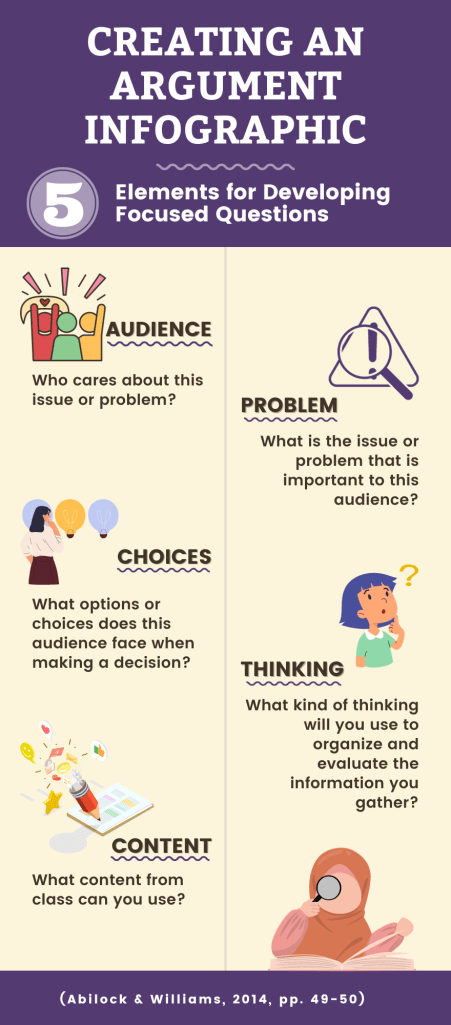
Good argument infographics start with inquiry. Students’ inquiry begins with questions. Students might typically start with the K-W-L strategy to formulate questions (Ogle, 1986) to orient their inquiry. Abilock and Williams (2014) argue that this is not enough. To be relevant, students must consider the infographic’s audience and purpose. Abilock and Williams propose five elements that students’ questions should address. Those are outlined in the infographic to the right.
Application in the Math Classroom

Hawley and Turner (2017) share the following suggestion as a possible classroom activity using infographics. “Identify a local issue of importance to the school or community. Design a survey and distribute it through social media. Using the data that is collected, have students take a stand and create infographics to share” (p. 80). This type of activity could be used to address the Alabama Content Standards for Mathematics. Under the Data Analysis, Statistics, and Probability content area, one of the focus areas states that “data arise from a context and come in two types: quantitative (continuous or discrete) and categorical. Technology can be used to “clean” and organize data, including very large data sets, into a useful and manageable structure–a first step in any analysis of data” (Alabama State Department of Education, 2019, p. 136).

I could see this being used with an issue my school is looking into this year. We are considering revising our bell schedules for the 2024-2025 school year. Many students would like the opportunity to take more electives than they currently do. Teachers would like to see some type of study hall built into the school day to assist students who need extra help. This provides an excellent real-world scenario of where mathematics can be applied to help answer questions. We could involve students in this real-world problem. Students could help design a Google Form to collect the preferences of students, teachers, and parents. After collecting the information, students could analyze and organize the data by creating infographics to help share the collected data with all stakeholders in our school community. Each grade level could analyze their data and the school as a whole.

References

Abilock, D., & Williams, C. (2014). Recipe for an Infographic. Knowledge Quest43(2), 46–55.

Alabama State Department of Education. (2019). 2019 Alabama course of study: Mathematics.

Ogle, D. M. (1986). K-W-L: A teaching model that develops active reading of expository text. Reading Teacher, 39(6), 564–570.

Turner, K. H., & Hicks, T. (2017). Argument in the real world: Teaching adolescents to read and write digital texts.

Zeevi, D. (2013). What makes a good infographic? [Photograph]. Flickr. https://flic.kr/p/dSxX4V

Unlocking Mathematical Minds: Harnessing the Power of Blogging for Critical Thinking

Currently, I am reading Argument in the Real World by Kristen Hawley Turner and Troy Hicks. The authors argue for using social media to help students develop their skills in writing digital arguments. These skills are necessary to see students move from consuming content online to creating their own content. Creating content requires students to be able to express their ideas clearly and be able to defend them.

Turner and Hicks (2017) state that “practicing the moves of argument–with both print and digital writing–will help students become more proficient as critical thinkers” (p. 14). Some of the “moves” that Hawley Turner and Hicks discuss in their book include: using images to both make claims and provide evidence, using evidence to support claims, formulating counterclaims, and choosing design elements to reinforce the ideas a writer is trying to communicate. As a former math teacher, this made me wonder how writing, digital writing in particular, could be used to promote critical thinking in the math classroom. How might a digital medium like blogging be used to develop critical thinking skills? What does research say about the role of writing in the math classroom?

Current Standards

The National Council of Teachers of Mathematics (NCTM) views communication as integral to learning mathematics. NCTM (2000, p. 60) states in its Communication Standard that

Instructional programs from prekindergarten through grade 12 should enable all students to–

  • organize and consolidate their mathematical thinking through communication;
  • communicate their mathematical thinking coherently and clearly to peers, teachers, and others;
  • analyze and evaluate the mathematical thinking and strategies of others;
  • use the language of mathematics to express mathematical ideas precisely.

The Common Core State Standards for Mathematics include Standards for Mathematical Practice. These standards list activities that students should be engaging in across all levels of mathematics. One of the standards specifies that all students should be able to “construct viable arguments and critique the reasoning of others” (Council of Chief State School Officers, 2010, p. 6). This standard proposes that students at all grade levels “can listen or read the arguments of others, decide whether they make sense, and ask useful questions to clarify or improve the arguments” (Council of Chief State School Officers, 2010, p. 7). In the video below, NCMT (2015) provides examples of what this standard looks like in action in the classroom.

YouTube Video from NCTM describing Constructing Viable Arguments and Critiquing the Reasoning of Others [Through Time Stamp 7:06]

Using Blogs as a Medium for Critical Thinking and Reasoning

Given the importance of communication in learning mathematics, blogs seem suitable for students to organize their thoughts and communicate their mathematical thinking. With the ability to comment on posts, students also have opportunities to critique the reasoning of others and justify their thinking. Through their writing, students practice using mathematical language to attend to precision when expressing their ideas. Cooper (2012) characterizes blogs as “a prime location for students to use writing to create depth of understanding, record their thinking, and communicate with peers or the instructor” (p. 80).

Turner and Hicks (2017) discuss how images can be used as evidence when making claims. Blogs allow students to incorporate images, graphic organizers, video clips, and visual aids into their writing.

Using digital tools, like Desmos, students can incorporate their own images that model their understanding of a specific problem. Using this type of media increases students’ ability to express their mathematical ideas and justify their reasoning (Cooper, 2012).

Depending on the age of the students, blogs could be opened up to others outside of the classroom. For example, an actuary could be invited to respond to students’ blog posts in a statistics class at the high school level. This would definitely motivate those students who ask, “When will we ever use this?” Opening up blogs to people outside of the school would be trickier with younger students, where the Children’s Internet Protection Act (CIPA) comes into play.

Used correctly, blogs allow students to take ownership of their learning because they can express what they do and do not know. They can ask questions and receive feedback. Blogs can provide students a space to continue to think and reflect on problems outside of the classroom. This could be a game changer for students who need extra time to process and reflect. Blogs could also serve as a type of digital portfolio where students have a written record of their thinking and how their understanding changes over time.

Challenges

There is no doubt that blogs have the potential to be an excellent communication tool to help students develop the ability to express and defend their ideas clearly and justify their reasoning. The main challenge I see with using blogs deals with time. Teachers will need time to become comfortable with using blogs so that they can guide students in setting up their blogs.

Students will also need time to become comfortable with creating blogs and appropriate ways of sharing their ideas and critiquing others. They will need time to slow down and think about how they want to formulate their ideas. Students will also need time to read and formulate their critiques when responding to their peers’ blog posts. However, this investment of time would reap great rewards as students become better critical thinkers.

The other challenge I can see with using blogs in the classroom deals more with classroom management. Some students can be easily distracted while using computers. The temptation to open up other tabs and get off-task is a problem for some students. Just as they would with any use of technology, teachers must be vigilant in supervising students and helping them to remain on task.

References

Cooper, A. (2012). Today’s technologies enhance writing in mathematics. The Clearing House, 85(2), 80-85. https://doi.org/10.1080/00098655.2011.624394

Council of Chief State School Officers. (2010). Common core standards for mathematics. https://learning.ccsso.org/common-core-state-standards-initiative

Federal Communications Commission. (2019, December 30). Children’s Internet protection act. https://www.fcc.gov/consumers/guides/childrens-internet-protection-act

National Council of Teachers of Mathematics. (2000). Principles and standards for school mathematics.

National Council of Teachers of Mathematics. (2015, April 10). Standards for mathematical practice [Video]. YouTube. https://www.youtube.com/watch?v=rLQI-CyXqc0&t=426s

Turner, K. H., & Hicks, T. (2017). Argument in the real world: Teaching adolescents to read and write digital texts.