As part of a course I am taking on distance education, I was asked to reflect on my own experience with distance learning. Specifically, I was asked to think about one positive experience and one negative experience. The origin of distance education can be traced back to correspondence courses conducted through the mail. Since then the method of delivering online courses has evolved as technologies have evolved.
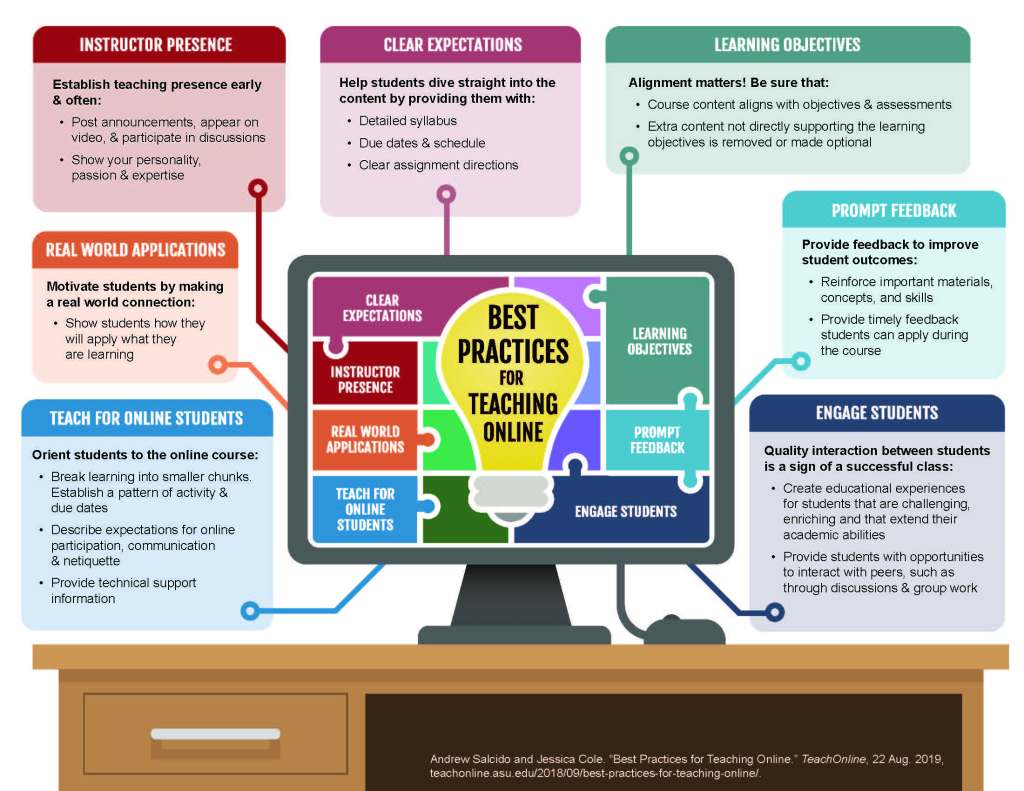
Regardless of the method of delivery, one of the defining characteristics of distance education is the separation of the student and the teacher in terms of location and time (Simonson & Zvacek, 2024). Researchers have defined best practices to help make the experiences of the remote learner equivalent to those of the in-person learner. Some of these best practices can be seen in the graphic below.
The Positive
One of the positive experiences I had with distance learning dealt with a recurring activity I completed with my classmates. In this particular class, we were assigned to small groups at the beginning of the online course. Toward the end of each module of the course, the small groups scheduled a convenient time for all the members to meet via Zoom and discuss the readings from the modules and share the connections we were making between the course content and our personal experiences. We then reflected on our discussions and chose part of the discussion to focus on in a blog post.
There are several reasons this specific activity was favorable to me. First, this activity promoted a student-centered learning environment. As Simonson and Zvacek point out, a student-centered learning environment “strongly promotes active learning, collaboration, mastery of course material, and student control over the learning process” (2024, p. 111). By using the Internet and Zoom as a vehicle for interactivity, we engaged in active learning as we discussed the connections we made with the course material. In their review of the literature, Johnson et al. (2023) found distance learner’s perceptions of connection to others and course content are critical factors in effective online learning.
Next, incorporating learner autonomy and involvement is an essential component of distance education (Simonson & Zvacek, 2024). My group and I were provided autonomy in what topics we chose to focus on in our discussions as well as when we would meet via Zoom to have our discussions. These interactions helped me to appreciate how the content of the course could be applied and used in different contexts based on the varied experiences shared by all of my group members. Interaction is an important component of effective distance education. Simonson and Zvacek state that “student to student and student to content interaction are the most important” (2024, p. 78). Other studies have also found that incorporating small groups into discussions increases participation and engages students in deeper conversations (Winger, 2022).
The second part of this activity required me to reflect on the group discussion and focus on something that resonated with me and my experiences. Again, this encouraged autonomy in my choice of what I would focus on for my blog post. I was also provided a choice of what media I would include in the blog post to enhance my post. The blog postings served as a means for me to demonstrate my understanding of the course material. This type of reflection is important in distance learning because it helps students connect with course content “through reflection that focuses on finding relationships and relevance of course content to their own life experience” (Johnson et al., 2023, p. 373).
The Negative
The only negative experience I have had with distance learning relates to feedback. In one of the first online courses I took in graduate school, we were introduced to blogs as a medium for reflection. There was a little bit of a learning curve that went along with creating a blog from scratch and then learning to incorporate different media within a blog post. There was plenty of information on the Internet that discussed how to utilize the features of the blog host I chose to use. What was frustrating was waiting to receive feedback from the instructor as to whether I was being critical enough in my blog reflections. On several occasions, I would not have feedback from a blog post before the next blog post would be due. This made me apprehensive and unsure of the quality of my work at the beginning of my first semester back in graduate school. Simonson & Zvacek (2024) reported that timely and useful feedback helps to develop stronger relationships between instructors and students. Other studies have also shown that timely, specific feedback helps learners reflect on their performance and make changes to increase their learning outcomes (Weru, 2023).
Lingering Thoughts
I am pleased to say that lag time in feedback is the only negative experience I have encountered with the distance learning courses I have completed. When reflecting on my first year in an online graduate program, I am very happy with the experiences I have had. Compared to the face-to-face program I completed for my master’s degree, I feel like I am putting in as much if not more work in this online program. I also feel like I am also spending more time reflecting and applying what I am learning in my coursework to my professional life.
References
Drexel University Online. (2017, December 18). A brief history of distance education. [Video]. YouTube. https://www.youtube.com/watch?v=6NfQDnVLZSA
Johnson, C. C., Walton, J. B., Strickler, L., & Elliott, J. B. (2023). Online teaching in K-12 education in the United States: A systematic review. Review of Educational Research, 93(3), 353–411. https://doi.org/10.3102/00346543221105550
Salcido, A., & Cole, J. (2018, September 10). Best practices for teaching online [Infographic]. Arizona State University. https://teachonline.asu.edu/2018/09/best-practices-for-teaching-online/
Simonson, M. R., & Zvacek, S. (2024). Teaching and learning at a distance: Foundations of distance education (8th ed.). Information Age Publishing, Inc.
Weru, N. (2023). The role of instructors support and feedback on the performance of online and distance Learning. International Journal of Online and Distance Learning, 4(1), 35-46. https://doi.org/10.47604/ijodl.2001
Winger, A. (2022). Deepening discussion in online learning through high-impact practices. The Quarterly Review of Distance Education, 23(3), 129–134.
 Ed Tech Wolfe