My O-P-L Record: Reflecting on My Experiences in the Instructional Technology Ed.S. Program

As I prepare to conclude my studies in the Ed.S. Instructional Technology program at the University of Montevallo, I am submitting my Observer-Participant-Leader (O-P-L) record. This document chronicles activities I completed while enrolled in courses in the program and working as an Instructional Technology Specialist with Homewood City Schools. This blog post reflects on three key activities from my O-P-L record and their connection to the Certified Education Technology Leader (CETL) Framework of Essential Skills.

PLC Book Study Presentation

For my final project in ED 629: Survey of Instructional Technology Leadership, I delivered a presentation on Matt Miller’s (2023) AI for Educators: Learning Strategies, Teacher Efficiencies, and a Vision for an Artificial Intelligence Future. I later utilized this presentation in a professional learning session at my school in Spring 2024. At that time, the use of artificial intelligence (AI) in education was rapidly expanding, but many teachers in my district were hesitant, perceiving AI as a tool that students might use to cheat.

My presentation initiated important conversations across departments about how AI could enhance instruction by fostering student reflection and critical thinking. For instance, we explored incorporating AI chatbots into “think-pair-share” routines and using them to facilitate classroom debates. These activities demonstrated how AI can elevate instructional strategies by engaging students in deeper learning.

We also discussed how AI could support educators. Teachers expressed interest in using AI to personalize learning experiences tailored to students’ interests and to differentiate instruction. For example, we examined how AI could generate questions and prompts aligned with students’ current learning progressions.

The dialogue around AI integration continues at my school, and most teachers have begun gradually introducing AI tools. Our district recently adopted School AI, which allows educators to establish boundaries for student interactions with AI. The ability to specify what students can and cannot do with SchoolAI has addressed teachers’ initial concerns regarding students misusing AI. These ongoing professional learning experiences exemplify CETL Framework Skill 1E (Consortium for School Networking [CoSN], 2018), which emphasizes leveraging emerging technologies like AI to enhance education.

Wakelet Board

Wakelet, a digital communication tool, played a significant role in both ED 629: Survey of Instructional Technology Leadership and ED 601: Instructional Design and Development. In ED 629, I used Wakelet to organize and share resources with classmates, while in ED 601, I created a personal Wakelet collection for a getting-to-know-you activity (Wakelet Course Introductions). These experiences highlighted Wakelet’s versatility as a tool for curating resources, sharing information, and collaborating on projects.

I also saw Wakelet in action at the 2024 ALET Fall Conference, where presenters used it to share resources with attendees. Inspired by this, I incorporated Wakelet into my professional practice. For example, I created a Wakelet collection to curate resources for the PLC Book Study presentation described earlier and shared it with my teachers during a professional learning session (Wakelet PLC: AI for Educators). They appreciated how easily resources could be organized and accessed in one location.

This ability to communicate and collaborate using digital tools like Wakelet aligns with CETL Framework Skill 7B (CETL, 2018). Integrating Wakelet into my instructional practice enhanced my ability to efficiently connect educators with valuable resources.

Data Management: OneToOne Plus

As an Instructional Technology Specialist, I manage the inventory of both technology and non-technology assets in my building. Recently, we implemented OneToOne Plus, a system for tracking and managing inventory. This platform allows me to enter new assets, update their status when they are lost or damaged, and ensure proper disposal when they expire.

Click Image to See Larger Version of Screenshot from My OneToOne Plus

Beyond maintaining accurate records, I conduct inventory audits, reconcile discrepancies, and present reports to the school board. These responsibilities require strong organizational and data management skills, directly aligning with CETL Framework Skill 9B (CETL, 2018), which focuses on managing data effectively.

Closing Thoughts

Completing my O-P-L record has been a transformative experience professionally. When I began the Ed.S. program, I had just transitioned from a classroom teacher to an Instructional Technology Specialist, a role requiring new skills closely aligned with the CETL Framework of Essential Skills. Reflecting on my progress through the O-P-L record has highlighted my growth and solidified my confidence as a technology leader in my district.

References

Consortium for School Networking. (2018). Framework of essential skills. Retrieved January 20, 2025, from https://www.cosn.org/wp-content/uploads/2021/09/Framework-December-2018.pdf

Miller, M. (2023). AI for educators: Learning strategies, teacher efficiencies, and a vision for an artificial intelligence future. Dave Burgess Consulting.
The Impact Cycle and Coaching

This semester, I am taking a graduate course to learn more about instructional coaching and mentoring. Thinking back to when I started teaching in 1994, I was assigned a mentor teacher with whom I rarely had the chance to meet or interact. This was through no fault of my mentor, as she had no off period to focus on working with me, and our conference periods were at different times of the day. Most of our exchanges occurred during hall duty between classes. While I had a strong understanding of my content area, I could have greatly benefited from having an instructional coach to help me learn effective strategies for reaching my struggling students. Over the years I attended professional development programs and conferences, and I honed my craft and learned strategies to support all of my students. However, having a dedicated instructional coach would have made the process of meeting my students’ needs more timely.

The Impact Cycle

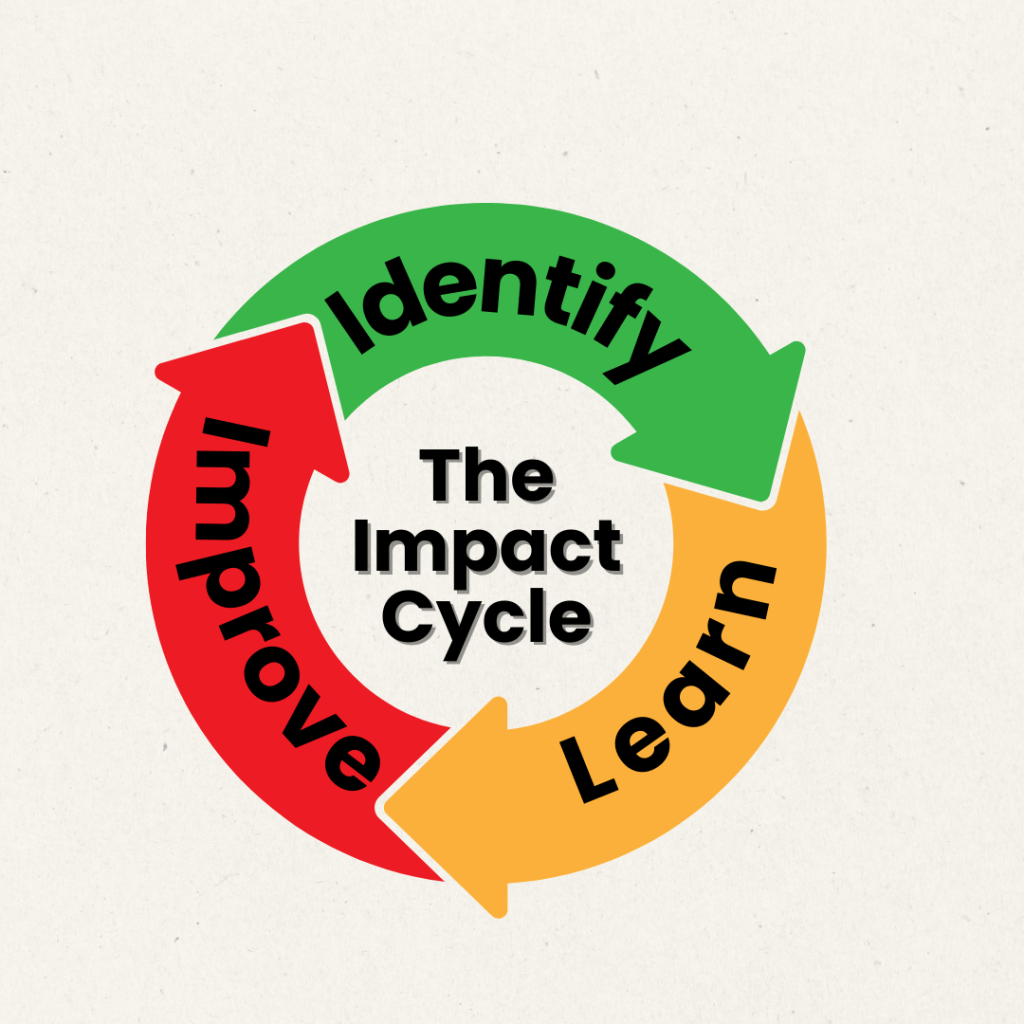
One of the projects I will undertake this semester is engaging in instructional technology coaching with some of the teachers at my school. In preparation for this, I have been learning about the Impact Cycle coaching model. Knight (2018) explains the model as having three parts: Identify, Learn, and Improve.

Note. From Jim Knight’s Impact Cycles Explained [Video], by TheOpenWindow, 14 September 2022, YouTube (https://www.youtube.com/watch?v=8i2hAB6JczA)

During the Identify stage, the instructional technology coach (ITC) and teacher work together to understand the current reality of the classroom. Once a clear picture is established, the ITC collaborates with the teacher to set goals. These goals, as well as all final decisions, are made by the teacher. After setting the goals, the ITC and teacher work together to identify potential strategies that could be employed to meet the goals. The final decision about which strategy to use remains with the teacher. The teacher retains their autonomy at all times and has the final say on all decisions.

Now that a goal and strategy have been decided upon, the process moves into the Learn stage. Here, the ITC provides a clear explanation of the strategy chosen by the teacher and offers opportunities for the teacher to see the strategy in practice. It is crucial for the teacher to both hear and observe the strategy being implemented.

The third stage of the cycle is the Improve stage. At this point, the teacher implements the strategy to reach the goal. Collaboration is key during this stage, as the ITC and teacher monitor progress and make adjustments as needed. These adjustments could involve tweaks to the teaching strategy or trying a new approach, effectively restarting the cycle.

Effective Coaching

Knight (2018) outlines seven Partnership Principles that effective ITCs uphold when partnering with teachers: equality, choice, voice, dialogue, reflection, praxis, and reciprocity. These principles are outlined in the infographic below.
Both the Impact Cycle and the Partnership Principles align with effective practices for instructional technology coaching found in the academic literature. Without a doubt, the most crucial practice when entering into a partnership with a teacher is to tailor support to the teacher’s specific needs and goals (Grierson et al., 2022). This concept ties back to the Identify stage of the Impact Cycle. Additionally, when working with teachers to integrate technology into their classrooms, coaches need to understand the teacher’s initial disposition toward technology integration (Ottenbreit-Leftwich et al., 2022).

Collaborative goal-setting is another critical component that helps teachers articulate their needs to set specific, measurable goals (Grierson et al., 2022). This collaboration serves as the impetus for action, leading to the selection of a strategy to achieve the established goals. Effective ITCs model technology integration and often co-teach with teachers (Grierson et al., 2022; Ottenbreit-Leftwich et al., 2022), aligning with the Learn stage of the Impact Cycle. This co-teaching also exemplifies the principle of praxis by implementing practical applications of technology in the classroom. Iterative reflection is another hallmark of effective ITCs (Grierson et al., 2022). Frequent debriefing to discuss successes and areas for improvement aligns with the Improve stage of the Impact Cycle.

Considering the dispositions of effective ITCs, the most critical factor for successful coaching is the ability to build safe, trusting relationships (Grierson et al., 2022). Without a strong ITC-teacher relationship, it is impossible to create a supportive, collaborative learning environment. Another equally important disposition is the ability to be flexible and responsive (Grierson et al., 2022). The needs of each teacher are unique and vary based on the composition of their classes. Flexibility and responsiveness in adjusting strategies based on dialogue and reflection are crucial to helping teachers achieve their goals.

Looking Ahead

As I learn more about the Impact Cycle for coaching, I am gaining confidence in undertaking the instructional technology coaching process with my teachers. I feel that I have a solid grasp of the Partnership Principles and already incorporate many of them into my interactions with the teachers in my building. I look forward to working with my colleagues and learning from one another as we engage in the coaching process.

References

r2ar. (n.d.). Communication [Icon]. The Noun Project. https://thenounproject.com/browse/icons/term/communication/

Coquet, A. (n.d.). Choice [Icon]. The Noun Project. https://thenounproject.com/browse/icons/term/equality/

Coquet, A. (n.d.). Reciprocity [Icon]. The Noun Project. https://thenounproject.com/browse/icons/term/reciprocity/

Cresnar, G. (n.d.). Thinking [Icon]. The Noun Project. https://thenounproject.com/browse/icons/term/thinking/

Grierson, A. L., Gallagher, T. L., & St Hilaire, R. (2022). Forging the role of the digital technology coach: flexibility, responsiveness, and resourcefulness in supporting teacher professional learning. Professional Development in Education, 50(1), 205–220. https://doi.org/10.1080/19415257.2022.2038657

Knight, J. (2018). The impact cycle: What instructional coaches should do to foster powerful improvements in teaching. Corwin, A SAGE Company.

‌Meiertoberens, L. (n.d.). Equality [Icon]. The Noun Project. https://thenounproject.com/browse/icons/term/equality/

Ottenbreit-Leftwich, A., Liao, Y.-C., Karlin, M., Lu, Y.-H., Ding, A.-C. E., & Guo, M. (2020). Year-long implementation of a research-based technology integration professional development coaching model in an elementary school. Journal of Digital Learning in Teacher Education, 36(4), 206–220. https://doi.org/10.1080/21532974.2020.1804494

Purnomo, E. (n.d.). Action [Icon]. The Noun Project. https://thenounproject.com/browse/icons/term/action/

TheOpenWindow. (2022, September 14). Jim Knight’s Impact Cycles Explained [Video]. YouTube. https://www.youtube.com/watch?v=8i2hAB6JczA

Warhammer. (n.d.). Listening [Icon]. The Noun Project. https://thenounproject.com/browse/icons/term/listening/

Reflecting on Instructional Design

As part of a wrap-up assignment for my ED 601 course on Instructional Technology, I was asked to reflect on the following questions:

  • How would you explain good instructional design to others?
  • What is something that you learned that you didn’t know before?
  • What is at least one thing you will change in your own design for future training sessions?
  • Provide a brief overview of the training you developed for this course (what it is, who it was designed for, highlight components of good instructional design you chose to use, etc.) and provide a link to the site where you hosted all of your information (presentation, handout, etc.).

Good Instructional Design

Brown and Green (2024) describe good instructional design as a reflective process that considers more than the information being presented in a lesson; it also gives equal importance to the learners, the organization of the information, and the presentation of the information. Each of the teachers in my building has different strengths and weaknesses. I have to adjust each training session I offer to tap into those strengths and address those areas of weakness. I also have to organize the information in a way that facilitates processing the information in the allotted training time I have with them each week. Finally, I have to consider that some of the teachers I train are more visual learners while others want to follow written instructions.

Something I Did Not Know Before

Considering the limitations on how the brain can process information and how that ties into how information is presented to learners is something that I had not considered before this course. Specifically, I am thinking of Mayer’s Principles for Multimedia Instruction. One of the principles discusses not adding on-screen text to narrated animation because this requires two different processing channels in the brain (Digital Learning Institute, 2024). This extra effort to process both inputs at the same time can limit how the brain processes the information and connects it to existing schemata. This has become an important consideration as I have been tasked with creating more training materials for my teachers.

One Change

One thing I do not do enough is provide my teachers the opportunity to give me feedback specific to the goals and objectives of each training I do with them. I plan on incorporating more of this into my training this school year. Given that most of my trainings deal with technology, I can assess a teacher’s skill level based on whether they can use an app or piece of technology effectively. Brown and Green (2024) discuss three types of evaluation: learner, formative, and summative. I already incorporate the learner and formative assessments as part of the training I do. It is the summative piece that I would like to focus on more. This type of assessment could provide valuable information that I can relay back to the central office regarding district-mandated programs or technology initiatives and how they are being utilized in the classroom.

My Instructional Design Project

My instructional design focused on training my teachers on the basics of using Chromebooks and how to perform basic troubleshooting. As my district moves to a one-to-one technology environment this school year, all students will now be issued a school Chromebook. Each of the teachers in my are issued a laptop and a Chromebook. Most of the teachers are more comfortable with a laptop and very rarely, if ever, utilize their Chromebooks. Teachers will need to be more comfortable using Chromebooks and troubleshooting common issues to help students.

To fine-tune the training, I incorporated a formative, pre-assessment component to take a temperature check on what each teacher is comfortable doing on the Chromebook. This information will be considered before the training is implemented with my teachers. Understanding the learner’s abilities is a crucial component of instructional design; it informs where I will start with my training and which topics I can simply review and which I need to spend a little more time on during the training.

I also considered how the information will be presented in the training. I incorporated both text and video instructions. In order to minimize the amount of information displayed on a single page, I included links to the videos I created that illustrated the skills outlined in the text on the screen. Teachers have a choice if they want to access and view the videos walking them through the skills. They decide how they want to interact with the information. Initially, I was going to include a GIF of each skill on the same slide as the instructions. I reconsidered this because I felt like it would be too overwhelming. While I still wanted to use the GIF, I ultimately decided it would be better to scrap the GIFs and instead make MP4s of each skill. This way, the learner can pause the video rather than having to wait for the GIF to repeat to see a step again.

Link to Instructional Design Project and Resources

Here is the Google Drive file housing all of the components of the training session I plan to implement with my teachers this September.

References

Brown, A. H., & Green, T. D. (2024). Essentials of instructional design: Connecting fundamental principles with process and practice (5th ed.). Routledge. 

Digital Learning Institute. (2024). Mayer’s 12 principles of multimedia learning. Retrieved July 22, 2024, from https://www.digitallearninginstitute.com/blog/mayers-principles-multimedia-learning 

Maintaining the Privacy and Security of Student Data

Recently, I found myself engaged in a discussion with some colleagues regarding security and ensuring that district and federal policies were being followed regarding student privacy and the security of student data. The teachers did not understand why they could not use a free digital resource with their students. This particular resource allowed users to utilize single sign-on with their school-issued Google accounts. The teachers’ thinking was that it was safe to use this resource because it was free and students did not have to create an account on the website. 

This conversation was very informative to me. While most teachers are aware of the Family Educational Rights and Privacy Act (FERPA), their view of privacy protection seems to be lacking a digital lens. As an Instructional Tech Specialist, I provide leadership in the area of student engagement and learning. This is one of the Pillars of Digital Leadership described by Sheninger (2019). Sheninger also describes this leadership role as being influenced by the Future Ready Framework–the Data and Privacy area in particular.

Privacy Laws

Two main federal laws regulate the privacy and security of student data: the Family Educational Rights and Privacy Act (FERPA) and the Children’s Online Privacy Protection Act (COPPA). 

Importance of Vetting Resources

Even with these laws in place, there are still issues with vendors not being completely transparent with their privacy policies or disregarding the requirements outlined in COPPA altogether (Frazier & Hearrington, 2024). For example, vendors who offer free services often share collected data with third parties to make money. These third parties can use this data to develop profiles of children and build behavioral ads targeting these children.

When viewed from the Data and Privacy area of the Future Ready Framework (All4Ed, 2024), technology leaders must ensure that procedures are in place to vet all digital resources to verify their educational value and security. When it comes to educational value, the resource should be judged on its ability to help teachers and students achieve learning targets. The content should also be developmentally appropriate for the intended age group. Considering security, the vendor of the resource “should encrypt user data to provide a basic assurance of security, especially products housing student data” (Zimmerle, 2021). As mentioned above, federal laws require that vendors clearly state within their privacy policies what data is collected from students and how that data is used. This is where the issue with free resources comes into play. Many free resources actually make money from selling or sharing student data. Often this data is used to create contextual or targeted advertising (Kelly, Graham, & Garton, 2023; Zimmerle, 2021).

Privacy Information Resources

Common Sense has a Privacy Program that evaluates the privacy policies of popular products to help schools and parents make informed decisions about the tools their students are using. Privacy evaluations are provided for a range of apps along with explanations of the ratings. Common Sense also provides access to publications, written by privacy law experts, that share information on important issues surrounding digital citizenship and student learning.

One such publication, the 2023 Privacy Program Evaluation Framework (Kelly, Graham, & Garton, 2023), assesses products using “multiple dimensions of privacy, safety, security, and compliance, incorporating criteria based on legal, societal, educational, and child development practices” (Common Sense Media, n.d.). The appendix of this report is extremely useful. When evaluating a product based on a specific component of law, the links in the appendix navigate to the questions that should be considered in the evaluation process.

Vetting Recommendations

Zimmerle (2021) recommends educating teachers on the law and why vetting is so important especially when it comes to free resources. Even if teachers have been trained on the importance of security and privacy of student data, the Federal Trade Commission (FTC) states that it is best practice for school districts to vet online resources instead of leaving it up to teachers (2020, July).

Note. From Adopting Ed Tech: Privacy Vetting [Video], by Student Privacy Compass, 13 August 2020, YouTube (https://www.youtube.com/watch?v=lU8v1orttis&t=629s)

When vetting resources, Student Privacy Compass, formerly known as FERPA|Sherpa, suggests asking the following ten questions (Gallagher, Magid, & Pruitt, 2021, p. 9 ).

  1. Does the product collect PII?
  2. Does the vendor commit not to share student information other than as needed to provide the educational product or service? The vendor should clearly promise never to sell data.
  3. Does the vendor create a profile of students, other than for the educational purposes specified?
  4. When you cancel the account or delete the app, will the vendor delete all student data that has been provided or created?
  5. Does the product show advertisements to students? Behaviorally targeted advertising is never acceptable for school use.
  6. Does the vendor allow parents to access data it holds about students or enable schools to access data so the school can provide the data to parents in compliance with FERPA?
  7. Does the vendor promise to provide security for the data it collects? Look for products that use encryption when storing and transmitting student data.
  8. Does the vendor claim it can change its privacy policy without notice at any time? The FTC requires vendors to provide notice to users when their privacy policies change and get new consent for the collection and use of their data.
  9. Does the vendor say that if the company is sold, all bets are off? The policy should state that any sale or merger will require the new company to adhere to the same protections.
  10. Do reviews or articles about the product or vendor raise any red flags?

Closing Thoughts

Thinking back to Sheninger’s (2019) description of the roles and qualities of an effective digital leader, I examined how I might be a more effective leader with regard to helping teachers understand the importance of Data and Privacy. With this in mind, I have redesigned my training with teachers to incorporate more of the information about the law and good practices I discovered in my research here. Before teachers request permission from the district to utilize new digital resources, they will now be able to examine these resources from a Data and Privacy perspective.

References

Children’s Online Privacy Protection Act of 1998, 15 U.S.C. §6501 et seq. (1998). https://www.govinfo.gov/content/pkg/USCODE-2022-title15/pdf/USCODE-2022-title15-chap91-sec6501.pdf 

Common Sense Media. (n.d.). Common sense privacy program: Publications. Retrieved from https://privacy.commonsense.org/resource/publications  

Family Educational Rights and Privacy Act of 1974, 20 U.S.C. § 1232g et seq. (1974). https://www.govinfo.gov/content/pkg/USCODE-2022-title20/pdf/USCODE-2022-title20-chap31-subchapIII-part4-sec1232g.pdf   

Federal Trade Commission. (2020, July). Complying with COPPA: Frequently asked questions. Retrieved from https://www.ftc.gov/business-guidance/resources/complying-coppa-frequently-asked-questions 

Frazier, M., & Hearrington, D. (2024). The technology coordinator’s handbook (4th ed.). International Society for Technology in Education.

Gallagher, K., Magid, L., & Pruitt, K. (2021). The educator’s guide to student data privacy. Student Privacy Compass. Retrieved from https://studentprivacycompass.org/audiences/educators/ 

Kelly, G., Graham, J., & Garton, S. (2023). 2023 Privacy Program Evaluation Framework. Common Sense Media.

Sheninger, E. (2019). Digital leadership: Changing paradigms for changing times (2nd ed.). Corwin; International Center for Leadership in Education.

Student Privacy Compass (2020, August 13). Adopting EdTech: Privacy vetting [Video]. YouTube. https://www.youtube.com/watch?v=lU8v1orttis&t=629s 
Student Privacy Compass (2024). Welcome to student privacy compass. https://studentprivacycompass.org/