
As a relatively new Instructional Tech Specialist at my school, I am always mindful of modeling best practices for my teachers when it comes to integrating technology into their lessons. As part of a graduate course I am taking, I am reading the Technology Coordinator’s Handbook. In Chapter 2 of the text, the authors discuss one role of a technology coordinator as supporting teaching and learning with technology (TLT). One of the ways that technology coordinators achieve this is by providing teachers professional development on instructional design processes that include the appropriate integration of technology (Frazier & Hearrington, 2017). The Analysis, Design, Development, Implementation, and Evaluation (ADDIE) Design Model was mentioned as a tool for both instructional planning and professional development. Since I had never heard of the ADDIE Model before, I decided to dig a little deeper to see how I might be able to utilize it in my role as an Instructional Tech Specialist.
The ADDIE Model
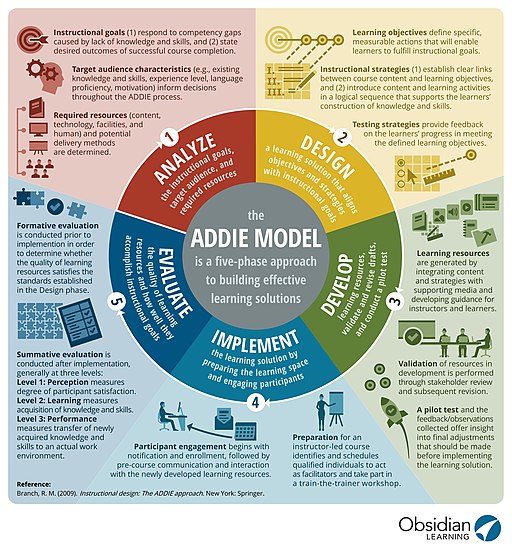
Here is a brief description of each stage of the ADDIE Model (Lu & Sides, 2022; Yeh & Tseng, 2019).
ANALYSIS STAGE
- Identify instructional problem
- Establish instructional goals
- Analyze goals and subordinate skills
- Identify the needs of students: What do they already know? What do they need to know?
- Identify the best learning environment
DESIGN STAGE
- Establish behavioral objectives and assessment instruments
- “Translate subordinate skills into measurable performance objectives and design parallel assessments” (Lu & Sides, 2022)
- Identify effective instructional strategies
- Select media and technological tools that support the instructional strategies and activities
DEVELOPMENT STAGE
- Create the instructional materials to be used based on the outline from the Design phase
- Check that materials and activities are aligned to the objectives
IMPLEMENTATION STAGE
- Teach the lesson
- Use formative assessments to collect feedback from students so adjustments can be made in the moment
EVALUATION STAGE
- Use data from formative assessments to analyze and improve the design of the lesson
- Use data from summative assessments to assess students’ mastery of instructional goals
TPACK
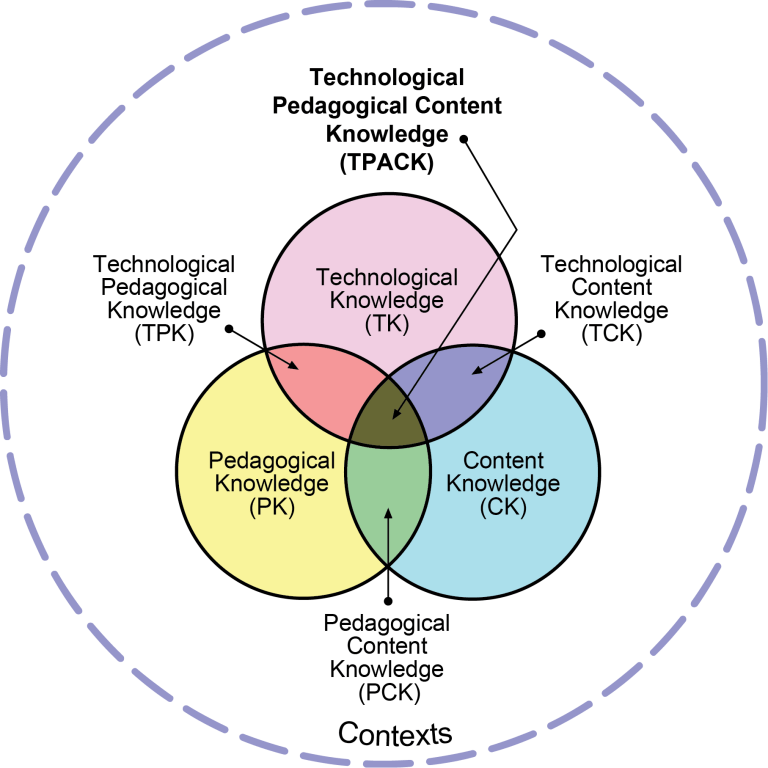
Our students live in a technology-rich world. They will be required to utilize technology in some way in their future careers. This means that we must equip students with the technological skills they will need. As a result, the knowledge teachers must know extends beyond content and pedagogical knowledge. They must also also have technological knowledge. The Technological Pedagogical Content Knowledge (TPACK) framework identifies “the nature of knowledge required by teachers for technology integration in their teaching, while addressing the complex, multifaceted and situated nature of teacher knowledge” (Koehler, September 24, 2012).
When considering the technological, pedagogical, and content knowledge needed for successful technology integration, the Design stage of the ADDIE model has been shown to enhance teachers Technological Knowledge (TK), Technological Content Knowledge (TCK), and Technological Pedagogical Knowledge (TPK) (Yeh & Tseng, 2019, p. 98).
As I reflected on the ADDIE Model, I noticed that it was similar to the Understanding by Design (UbD) Framework in that both models start with the end in mind before planning how to reach the instructional goals of the lesson. I am a big proponent of the UbD Framework for designing effective instruction. In this framework, lesson planning occurs in three stages: 1) identify desired results, 2) determine acceptable evidence, and 3) plan learning experiences and instruction (Wiggins & McTighe, 2005).
Some researchers have proposed a mashup of the ADDIE Model and UbD Framework to help teachers as they plan their instruction (Schwieger & Ladwig, 2021; Setiawan, 2022). The visual below represents how the stages align and overlap between the two instructional design models.
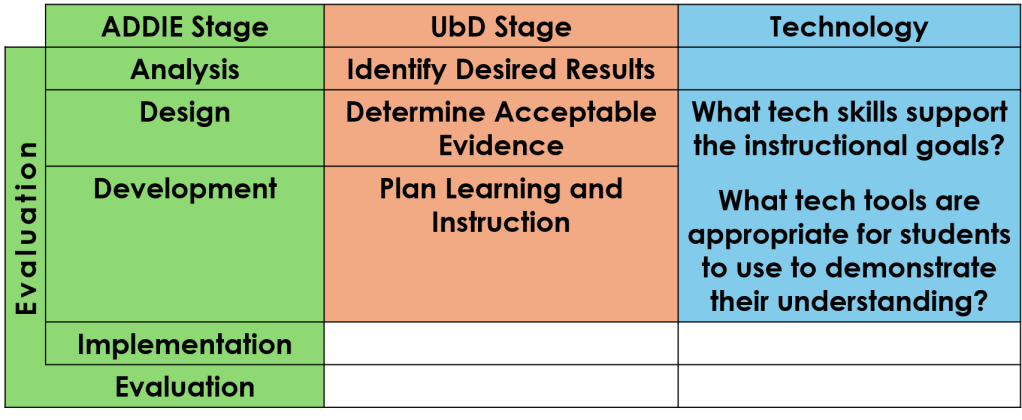
It should be noted that this model incorporates the cyclical view of the ADDIE Model with evaluation occurring not only at the end of instruction but also during the Analysis, Design, Development, and Implementation phases.
Lingering Thoughts
I am always looking for ways to help my teachers be more reflective and intentional with the technology they use with their students. We are currently in the process of reviewing the ISTE Standards for Students to see how they align with the learning targets in our core classes. As we begin to review and align the standards, this mashup model of the ADDIE and UbD Frameworks might be useful in helping teachers think critically about the learning activities they design and how students might be able to demonstrate their understanding through the use of technology. In particular, paying attention to specific tech skills students can use to demonstrate their understanding while also supporting the ISTE Standards for Students.
References
Amatya, G. (2022). Let’s talk ADDIE: It still matters. eLearning Industry. https://elearningindustry.com/lets-talk-addie-it-still-matters
Frazier, M., & Hearrington, D. (2017). The technology coordinator’s handbook (3rd ed.). International Society for Technology in Education.
Koehler, M. (2017, June 9). Tpack explained. TPACK.ORG. https://matt-koehler.com/tpack2/tpack-explained/
Kurt, S. (2018, December 16). Addie model: Instructional design. Educational Technology. https://educationaltechnology.net/the-addie-model-instructional-design/
Lu, L., & Sides, M. L. (2022). Instructional design for effective teaching: The application of ADDIE model in a college reading lesson. Practitioner to Practitioner, 11(1), 4-12.
NeuroFeedSnack. (2018, July 22). ADDIE model of instructional design [Video]. YouTube. https://www.youtube.com/watch?v=JxShaB4R0d8
Power, R. (2023). Everyday instructional design: A practical resource for educators and instructional designers. Power Learning Solutions. https://pressbooks.pub/everydayid/
Schieger, D., & Ladwig, C. (2021). Using a modified understanding by design framework to incorporate social media tools in the management information systems curriculum for generation Y and Z students. Journal of Information Systems Education, 32(3), 166-175.
Setiwan, A. A. (2022). Instructional design: Teaching algebraic equations to grade 8 students with involvement of mathematical reasoning in Cambridge IGCSE curriculum. Journal of Instructional Mathematics, 3(1), 1-15.
Wiggins, G., & McTighe, J. (2005). Understanding by design (2nd ed.). Association for Supervision and Curriculum Development.
Yeh, H. C., & Tseng, S. S. (2019). Using the ADDIE model to nurture the development of teachers’ CALL professional knowledge. Journal of Educational Technology & Society, 22(3), 88-100.
 Ed Tech Wolfe
Many of the veteran teachers have content and pedagogical knowledge but lack the technological knowledge. I agree, if educators are to equip students with the knowledge and skills they need for their future careers, educators must design instruction that incorporates the use of technology in a way that provokes higher order thinking skills. Frazier and Hearrington (2017) note that educators need professional development on how to use digital innovation and how to teach with the innovation. I am beginning to better understand my role as a leader in ensuring the structures are present to support my teachers’ needs as they relate to technology.
Frazier, M. & Hearrington, D. (2017). The Technology Coordinators Handbook (3rd ed). International Society for Technology in Education.
LikeLike