
Simonson and Zvacek (2024) define assessment as “the process of measuring, documenting, and interpreting behaviors that demonstrate learning” (p. 242). Assessment serves as a crucial feedback mechanism for both students and teachers. For students, it offers insights into their progress toward meeting course objectives, enabling them to make necessary adjustments and take responsibility for their learning. For teachers, assessment feedback provides an understanding of the effectiveness of instruction and course activities in facilitating student mastery of objectives, allowing them to make informed adjustments as needed.
For assessments to be effective, they must exhibit alignment, validity, reliability, and practicality (Simonson & Zvacek, 2024). Alignment pertains to the extent to which the assessment corresponds with the course objectives, both conceptually (content) and cognitively (thinking skills). Validity refers to the extent to which an assessment accurately measures its intended constructs. Reliability denotes the consistency and stability of an assessment in measuring its intended outcomes. Practicality involves considering factors such as the time required for students to complete the assessment, the resources needed, the time needed for scoring, and the usefulness of the information obtained from the assessment.
Portfolios as an Assessment Tool
Electronic portfolios (e-portfolios) can be utilized for both formative and summative assessments (Allman et al., 2021; Simonson & Zvacek, 2024). The type of assessment is determined by the tasks incorporated within the e-portfolio. Activities focusing on critical thinking, self-assessment, and self-reflection are formative, as they enable learners to gain deeper insights into their learning journey and connect theory with practice (Song, 2021). For summative assessment, specific activities must explicitly link the learner’s skills, knowledge, and accomplishments to the course’s desired learning outcomes (Song, 2021). When the task in the e-portfolio is used for summative assessment, the rubric and score should not be documented within the e-portfolio, especially in cases where the e-portfolio is shared publicly with others (Chang & Kabilan, 2024). In cases like this, it is better to communicate the score and rubric with feedback directly to the student through the course management system.
Chang and Kabilan (2024) contend that electronic portfolios (e-portfolios) offer a more authentic method for evaluating student learning and program success for administrators. Additionally, e-portfolios foster collaborative, reflective, and integrative learning (Chang & Kabilan, 2024; Song, 2021). Students exercise ownership over their learning by selecting artifacts and utilizing various modes of expression, including oral, video, visual, and written formats (Chang & Kabilan, 2024; Simonson & Zvacek, 2024). Moreover, students generally hold favorable attitudes towards e-portfolios for both assessment and learning, which is likely due to the connections they make between course content and their career aspirations (Allman et al., 2021).
E-portfolios have the potential to be a useful tool for assessment when designed correctly. In general, e-portfolios exhibit high validity because they allow students to independently gather, select, and reflect on evidence of their learning for formative purposes (Lam, 2023). Care should be taken to prevent the contents of the e-portfolio from being too narrowly defined as this may decrease the validity since students end up simply providing content rather than engaging in reflective thinking (Lam, 2023). While it does appear that well-defined rubrics aligned to the desired learning outcomes of the course increase reliability, more research is needed to clarify the reliability of e-portfolios (Lam, 2021, 2023). Finally, the practicality of e-portfolios depends on the computer literacy of both the students and instructors to manage their e-portfolios.
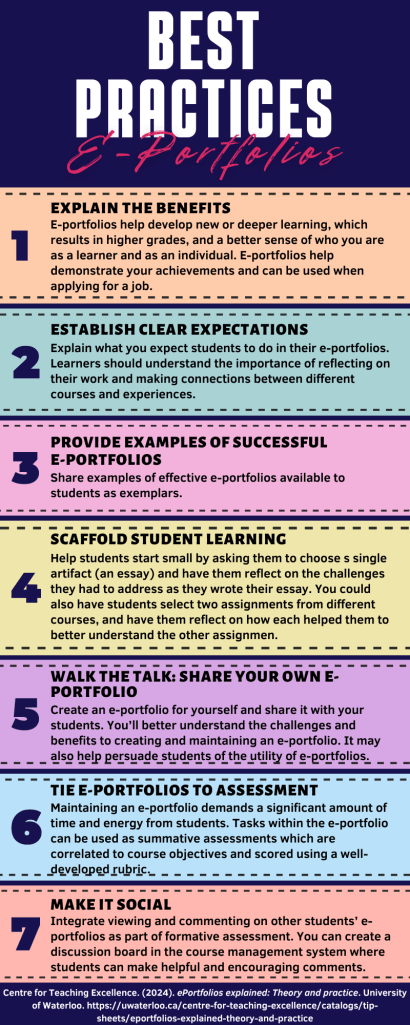
At the right are some best practices for instructors to consider when using e-portfolios with their students (University of Waterloo Centre for Teaching Excellence, 2024). In addition, the University of Waterloo provides an example of one of their student’s e-portfolios.
Digital Tools for e-Portfolios
Several digital tools support the creation of e-portfolios. These include FolioSpaces (free), Blackboard ePortfolio, Digication ePortfolios, and Mahara. As mentioned above, students need to be aware of e-portfolio expectations before and during their engagement with their e-portfolios. In addition, to realize the full benefits of using e-portfolios, students need continuous support with the technological aspects of the e-portfolio system.
Many course management systems have some type of e-portfolio system add-ons, such as the Blackboard ePortfolio. While these add-ons may be convenient for integrating the e-portfolio within the course management system, there are some drawbacks to consider (Chang & Kabilan, 2024). First, once students graduate and are no longer associated with the university, they may lose access to their e-portfolio. Second, students may be unable to share their e-portfolios outside of the institution. This would make it difficult for students to share their e-portfolios with prospective employers if they are applying for a job.
Closing Thoughts
E-portfolios have the potential to be useful assessment tools in online learning. How useful they are depends on the alignment between the tasks in the e-portfolio and the course objectives. As a form of authentic assessment, e-portfolios help students connect content to real-world tasks related to course objectives. These connections help students see and appreciate the value of what they are learning which can increase engagement and motivation.
References
Allman, A., Kocnevaite, A., & Nightingale, F. (2021). The effectiveness of online portfolios for assessment in higher education. In The IAFOR International Conference on Education–Hawaii 2021 Official Conference Proceedings (pp. 469-480).
Centre for Teaching Excellence. (2024). ePortfolios explained: Theory and practice. University of Waterloo. https://uwaterloo.ca/centre-for-teaching-excellence/resources/integrative-learning/pebblepad/examples-student-eportfolios
Chang, S. L., and Kabilan, M. K. (2024). Using social media as e-Portfolios to support learning in higher education: A literature analysis. Journal of Computing in Higher Education, 36(1), 1-28. https://doi.org/10.1007/s12528-022-09344-z
Cruz, D. (n.d.). Danielle Cruz: Knowledge integration student. Retrieved June 17, 2024, from https://daniellemcru.wixsite.com/eportfolio/portfolio
Foliospaces. (2016, May 25). What is FolioSpaces? [Video]. YouTube. https://www.youtube.com/watch?v=cKeWzxBZAy4&t=5s
Lam, R. (2021). Test usefulness of e-Portfolios: An alternative approach during and beyond the pandemic. In K. Sadeghi (Ed.), Technology-assisted language assessment in diverse contexts: Lessons from the transition to online testing during COVID-19 (pp. 181-195). Routledge. https://doi.org/10.4324/9781003221463-15
Lam, R. (2023). E-portfolios: What we know, what we don’t, and what we need to know. RELC Journal, 54(1), 208-215.
Simonson, M. R., & Zvacek, S. (2024). Teaching and learning at a distance: Foundations of distance education (8th ed.). Information Age Publishing, Inc.
Song, B. K. (2021). E-portfolio implementation: Examining learner’s perception of usefulness, self-directed learning process. Australasian Journal of Educational Technology, 37(1), 68-81.
 Ed Tech Wolfe
Walland (2022) believes that e-portfolios are being used in a transformative way that will transform teaching and assessment. My first exposure to e-portfolios took place in our current graduate program. E-Portfolios can be designed using a variety of methods, such as blogging, written reflections, and media projects. I like that I can see my blogging topics from the beginning of the program to now. The development of portfolios for students in distance education has the potential to establish meaningful connections with the instructors (Simonson et al., 2024). Furthermore, connecting e-portfolios to real-world tasks can help with student engagement, a crucial part of distance education.
Simonson, M. R., & Zvacek, S. (2024). Teaching and learning at a distance: Foundations of distance education (8th ed.). Information Age Publishing, Inc.
Walland, E., & Shaw, S. (2022). E-portfolios in teaching, learning and assessment: tensions in theory and praxis. Technology, Pedagogy and Education, 31(3), 363–379. https://doi.org/10.1080/1475939X.2022.2074087
Tomeka Jones
LikeLike
Hi Kevin!
Great thoughts on eportfolios! I’ve had to create portfolios for students under the Literacy Act. I find portfolios very valuable and the fact that they can be digitized makes them even more valuable. Yang, Wang, and Lim assert that “there are two essential benefits of e-portfolios, namely: (a) empowerment and ownership of learning for students and (b) feedback and interactivity by drawing on digital technology”. A similar thought is echoed by Simonson and Zvacek in chapter 9.. The authors state that “students working at a distance the development of portfolios can provide a meaningful connection with the instructor as criteria are established, materials are exchanged, and timelines for completion negotiated” (Simonson and Zvacek, 2024, p. 253). These statements tell me that portfolios have substance and provide students with opportunities to build relationships and learn valuable skills.
Jennifer Richardson
LikeLike
Edited to add:
References:
Yang, M., Wang, T., Lim, C.P. (2023). E-portfolios as Digital Assessment Tools in Higher Education. In: Spector, J.M., Lockee, B.B., Childress, M.D. (eds) Learning, Design, and Technology. Springer, Cham. https://doi.org/10.1007/978-3-319-17461-7_83
Simonson, M. R., & Zvacek, S. (2024). Teaching and learning at a distance: Foundations of Distance Education. Information Age Publishing, Inc.
LikeLike